
York Region recognized for innovative, low-carbon road project on Leslie Street
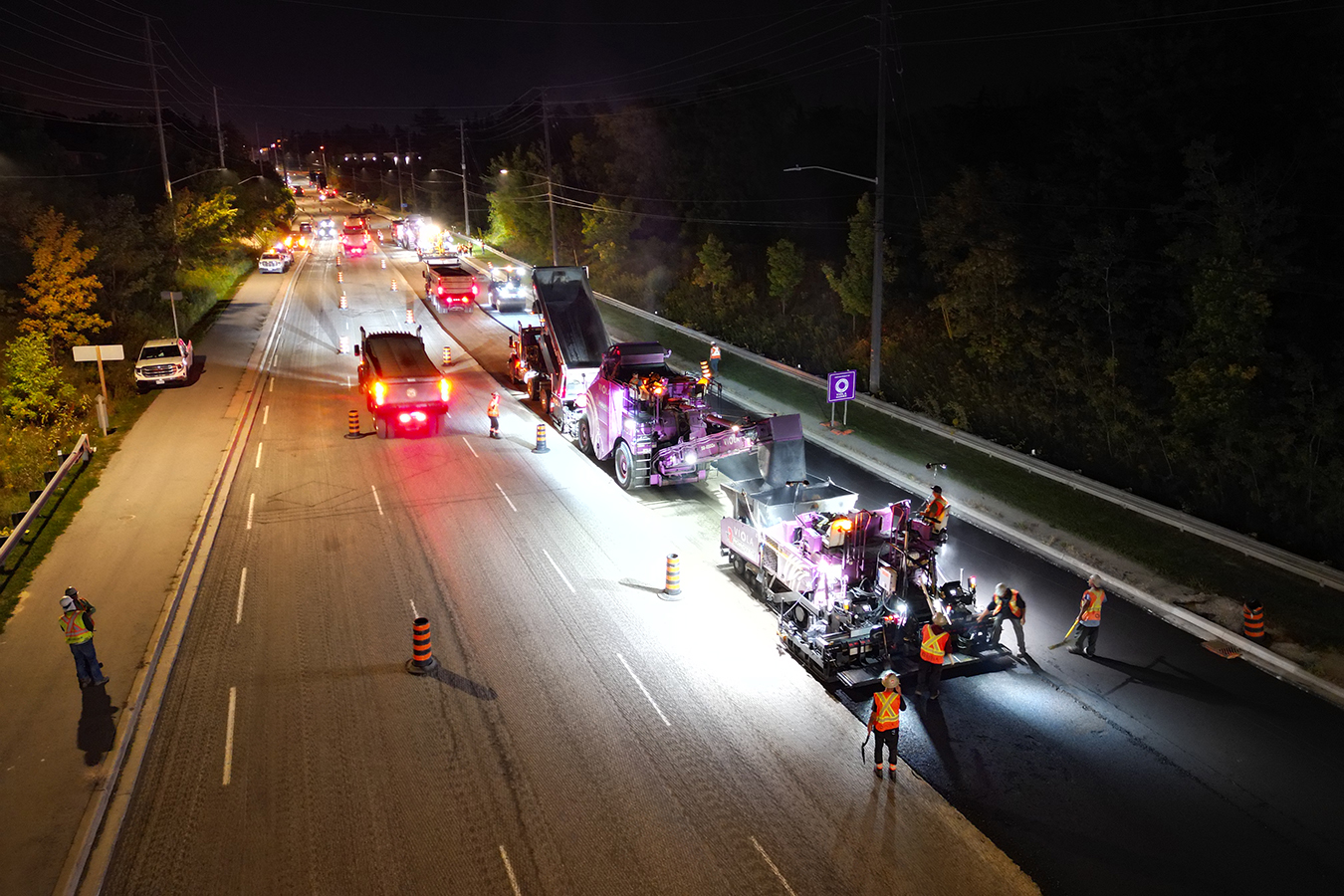
York Region is receiving national recognition for a pioneering road project that combines environmental sustainability with long-term cost savings.
The Region’s Leslie Street Rehabilitation Project, stretching from Highway 407 to Elgin Mills Road East in the cities of Markham and Richmond Hill, has earned two major honours: the Green and Climate Spotlight Award from the Canadian Network of Asset Managers and selection by the Ontario Public Works Association (OPWA) for its 2026 Technical Innovation Award.
The awards highlight York Region’s leadership in modernizing road construction while reducing environmental impacts.
A First for Canada
The Leslie Street project marks Canada’s first full-scale trial of performance-based warm mix asphalt using high levels of reclaimed asphalt pavement (RAP) in both road surface and base layers.
RAP is made from recycled asphalt removed from old roads. While it helps reduce waste and the need for new materials, its use has historically been limited in Ontario due to concerns about durability and consistency.
York Region’s project challenges those limits by safely increasing RAP content:
- 20–30% RAP in surface layers
- 30–40% RAP in base layers
Four trial sections were installed in the northbound lanes, while the southbound lanes were paved with conventional asphalt to allow direct comparison.
Technology Improves Performance
To ensure the recycled material performs well over time, the project used several advanced techniques:
- A rejuvenator was added to restore flexibility in older asphalt binder, helping prevent cracking and rutting
- Warm mix asphalt (WMA) technology lowered production temperatures by at least 20°C, reducing energy use
- Embedded sensors tracked temperature, moisture, stress and strain in real time under actual traffic conditions
The Region partnered with the National Research Council of Canada to monitor performance over the pavement’s lifecycle, combining field data with laboratory testing and emissions tracking.
Measurable Environmental Benefits
The Leslie Street project has already delivered clear environmental results.
By using approximately 5,200 tonnes of recycled asphalt, the Region avoided the production and transportation of new materials, reducing emissions by about 32 tonnes of CO₂ equivalent.
Warm mix asphalt provided additional benefits, cutting plant energy use and delivering a further 48 tonnes of CO₂ reductions.
In total, the project achieved about 80 tonnes of greenhouse gas savings, supporting York Region’s broader climate goals while demonstrating practical ways municipalities can lower emissions.
Cost Savings Without Compromising Quality
The innovation also proved financially beneficial.
High-RAP asphalt mixes reduced costs by:
- About $5 per tonne for base layers
- About $15 per tonne for surface layers
These savings added up to roughly $110,000 for the northbound lanes alone.
Despite the lower costs, early results show strong performance under real traffic conditions, supported by extensive pre-construction testing to confirm durability.
Part of a Larger Infrastructure Plan
The Leslie Street project is part of York Region’s $3.3 billion, 10-Year Roads Capital Construction Program, which focuses on balancing growth, asset management and sustainability.
The Region maintains more than 4,400 lane-kilometres of roads, and projects like this are shaping how future roads will be built and maintained.
Potential for Long-term Impact
Officials say the approach could be scaled across the entire road network, offering significant long-term benefits.
Over a 50-year period, using higher RAP levels could:
- Save 5.7 million tonnes of virgin materials
- Reduce emissions by approximately 110,000 tonnes of CO₂
- Generate about $2.7 million in annual cost savings
Setting a new Standard
The Leslie Street project introduces a performance-based approach to asphalt design, shifting away from strict material limits and focusing instead on how pavement actually performs in real-world conditions.
By combining recycled materials, advanced additives, lower-temperature production and real-time monitoring, York Region has created a model for sustainable road rehabilitation.
The project is now being viewed as a blueprint for municipalities across Canada, demonstrating that environmental responsibility, cost efficiency and infrastructure durability can go hand in hand.