
Intersection Safety Improvements
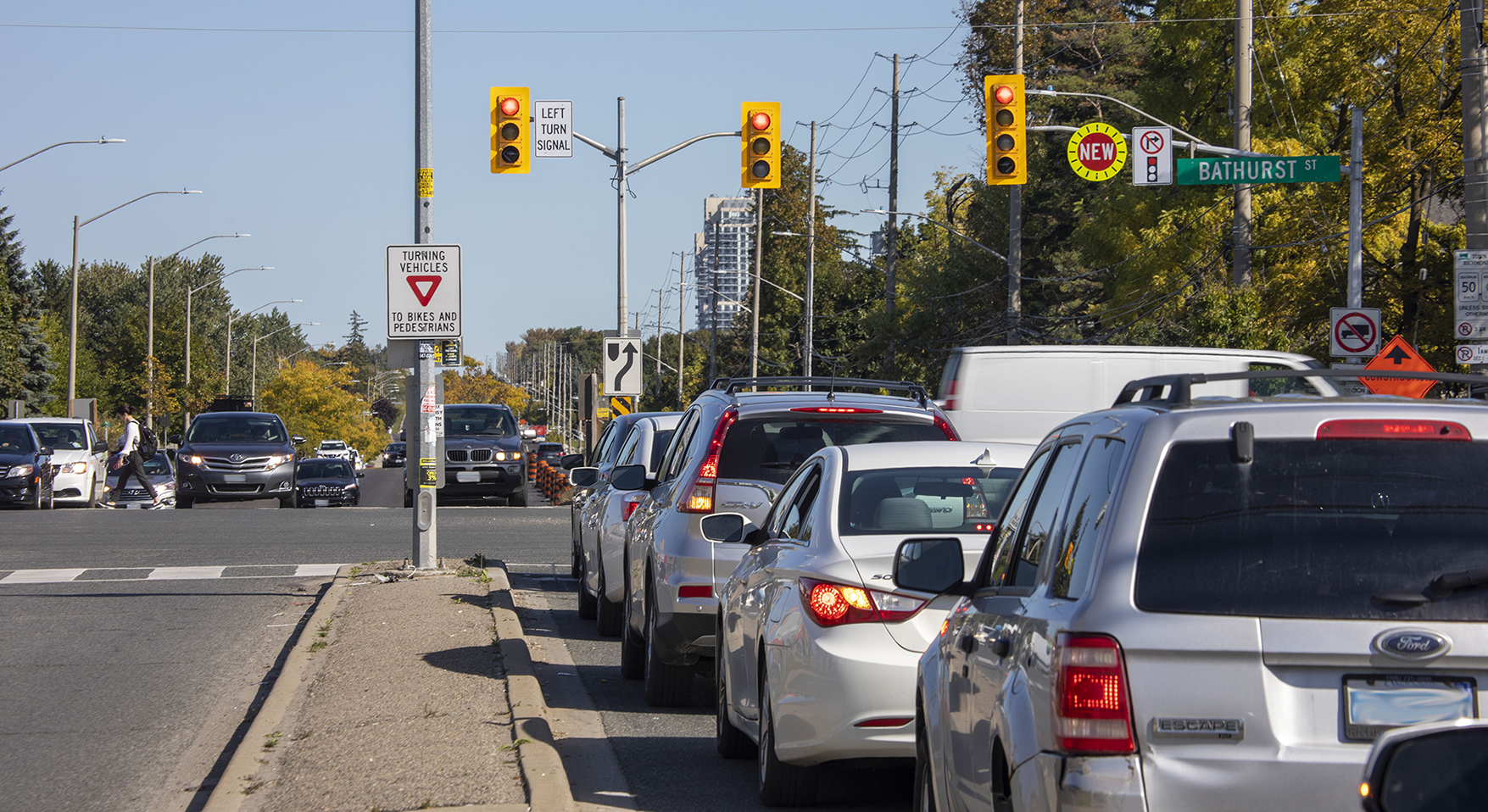
One of York Region’s top priorities is to reduce the number and severity of collisions that happen on Regional roads.
Using a data-driven approach, the intersection safety measures listed below, have been identified and selected as having the best opportunity to improve pedestrian and cyclist safety and have been implemented at several intersections.
- No right turn on red (NROR) during select times of the day
- Pedestrian head start
- Left turn signal
- U-turn restriction
- Additional warning signage
Intersections With Improvements
14th Avenue and 11th Concession
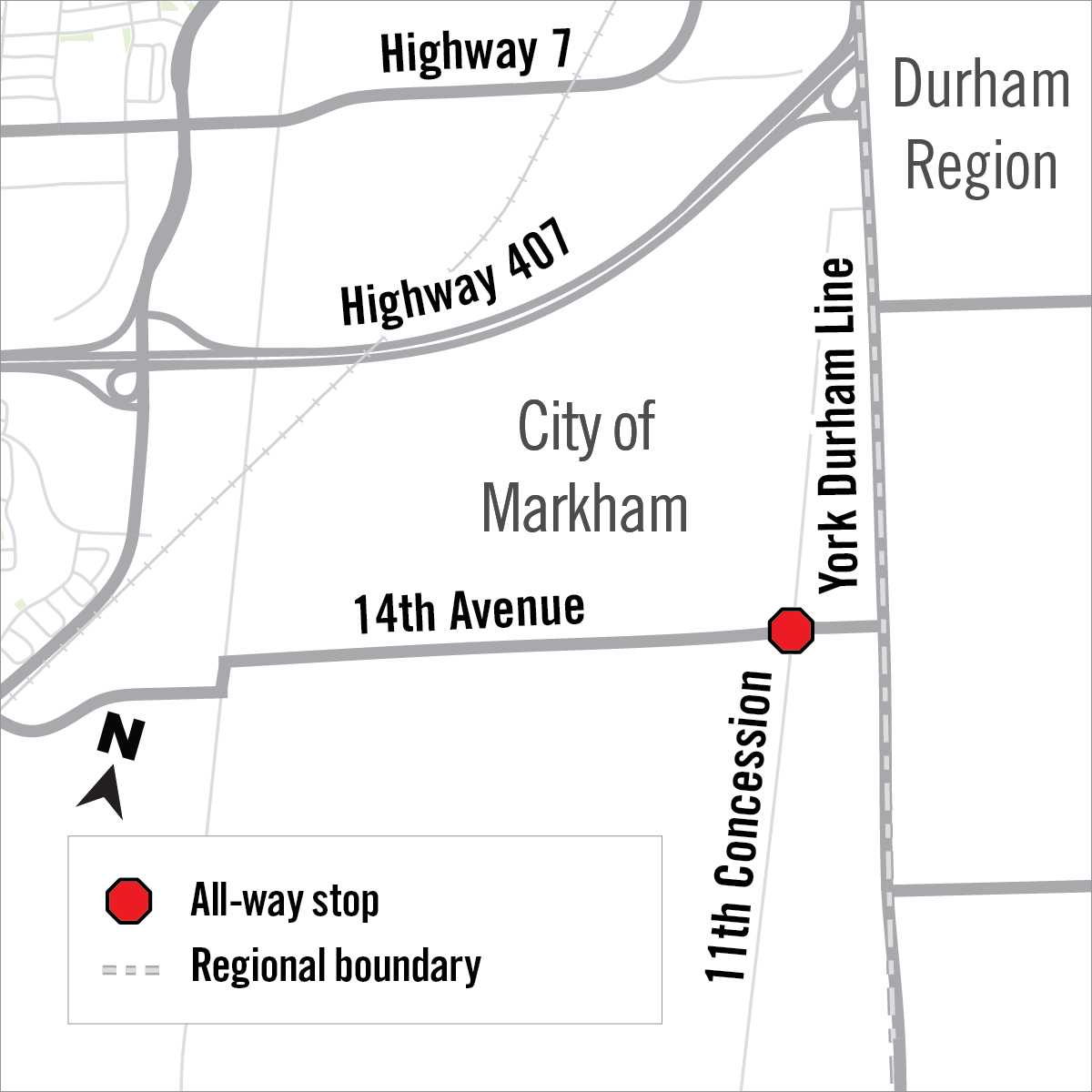
Safety Measures Implemented
- Upgrading the intersection from a two-way stop to an all-way stop
Frequently Asked Questions
Why were these safety measures implemented?
One of York Region’s top priorities is to reduce the number and severity of collisions that happen on Regional roads. Safety information and data are reviewed annually, and based on the results, improvements are made across the Region. This could include making improvements to existing roads and intersections, improving the design of new roads, law enforcement and raising public awareness. As outlined in York Region’s Vision Zero Traveller Safety Plan, all-way stops help reduce collisions, improve visibility and enhance the safety of all road users.
When will these safety measures be implemented?
The new safety measures will be implemented in August 2025.
How will these safety measures be enforced?
York Regional Police will enforce.
How was this plan shared with the community?
York Region mailed postcards to area residents, provided information on york.ca and promoted on social media.
16th Avenue and Peter Street
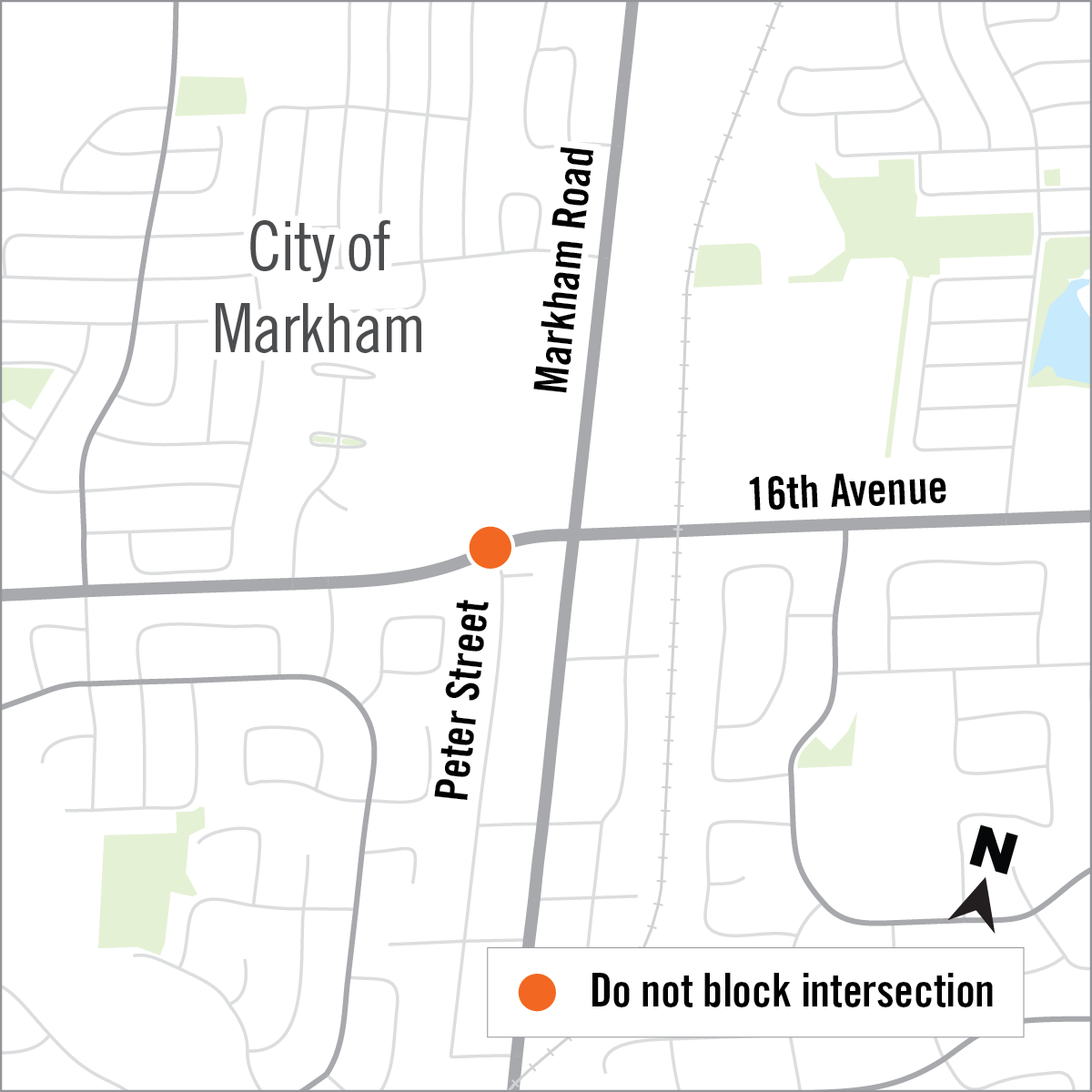
Safety Measures Implemented
- “Do Not Block Intersection” pavement markings and warning signs at the intersection of 16th Avenue and Peter Street
Frequently Asked Questions
Why were these safety measures implemented?
One of York Region’s top priorities is to reduce the number and severity of collisions that happen on Regional roads. Safety information and data are reviewed annually, and based on the results, improvements are made across the Region. This could include making improvements to existing roads and intersections, improving the design of new roads, law enforcement and raising public awareness.
The new traveller safety measures will reduce traffic delays and collisions involving turning vehicles. As outlined in York Region’s Vision Zero Traveller Safety Plan, these changes improves traffic flow and safety for all road users.
When will these safety measures be implemented?
The new traveller safety measures will be implemented in spring 2026.
How will these safety measures be enforced?
York Regional Police will enforce.
How was this plan shared with the community?
York Region mailed postcards to area residents, provided information on york.ca and promoted on social media.
16th Avenue and Woodbine Avenue
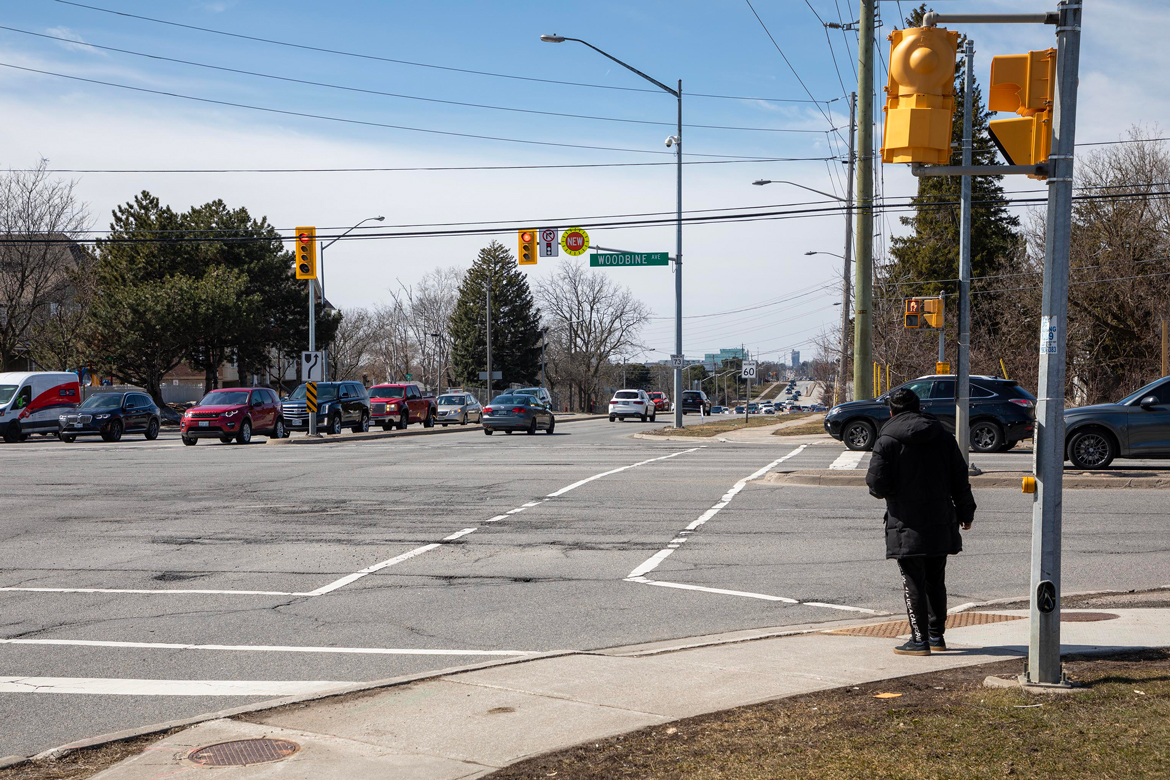
Safety Measures Implemented
- No right turn on red signal for drivers from 7 a.m. to 9 a.m. and 4 p.m. to 6 p.m. Monday to Friday
An additional safety measure coming in 2025 includes:
- A fully protected left-turn signal for northbound and southbound drivers
Frequently Asked Questions
Why were these safety measures implemented?
One of York Region’s top priorities is to reduce the number and severity of collisions that happen on Regional roads. Safety information and data are reviewed annually, and based on the results, improvements are made across the Region. This could include making improvements to existing roads and intersections, improving the design of new roads, law enforcement and raising public awareness.
Why was the no right turn on red implemented at this intersection?
This intersection ranked 10th in overall collision locations in Markham based on 2019 to 2021 collision statistics. York Regional Police collision data showed vehicles were not yielding right-of-way for pedestrians and cyclists. Collision statistics show that right-turning vehicles account for 30% of pedestrian collisions and 50% of cyclist collisions.
Why was the time-of-day feature added to the no right turn on red?
There was a high potential for pedestrian and cyclist collisions due to significant volumes during rush hours, which was the basis for implementing the time-of-day no right turn on red signal for drivers from 7 a.m. to 9 a.m. and 4 p.m. to 6 p.m. Monday to Friday
When were these safety measures be implemented?
No right turn on red signal was implemented in fall 2022. No right turn on red signal based on the time of day was implemented in June 2023.
How will these safety measures be enforced?
York Regional Police will enforce.
How was this plan shared with the community?
York Region provided information on york.ca, mailed postcards to the Markham community and promoted on social media.
Why will the new left-turn signal be added to this intersection in 2025?
To further protect pedestrians, students and cyclists from turning vehicles. Statistics show that left-turning vehicles account for 36% of pedestrian collisions and 14% of cyclist collisions.
9255 Woodbine Avenue at 16th Avenue
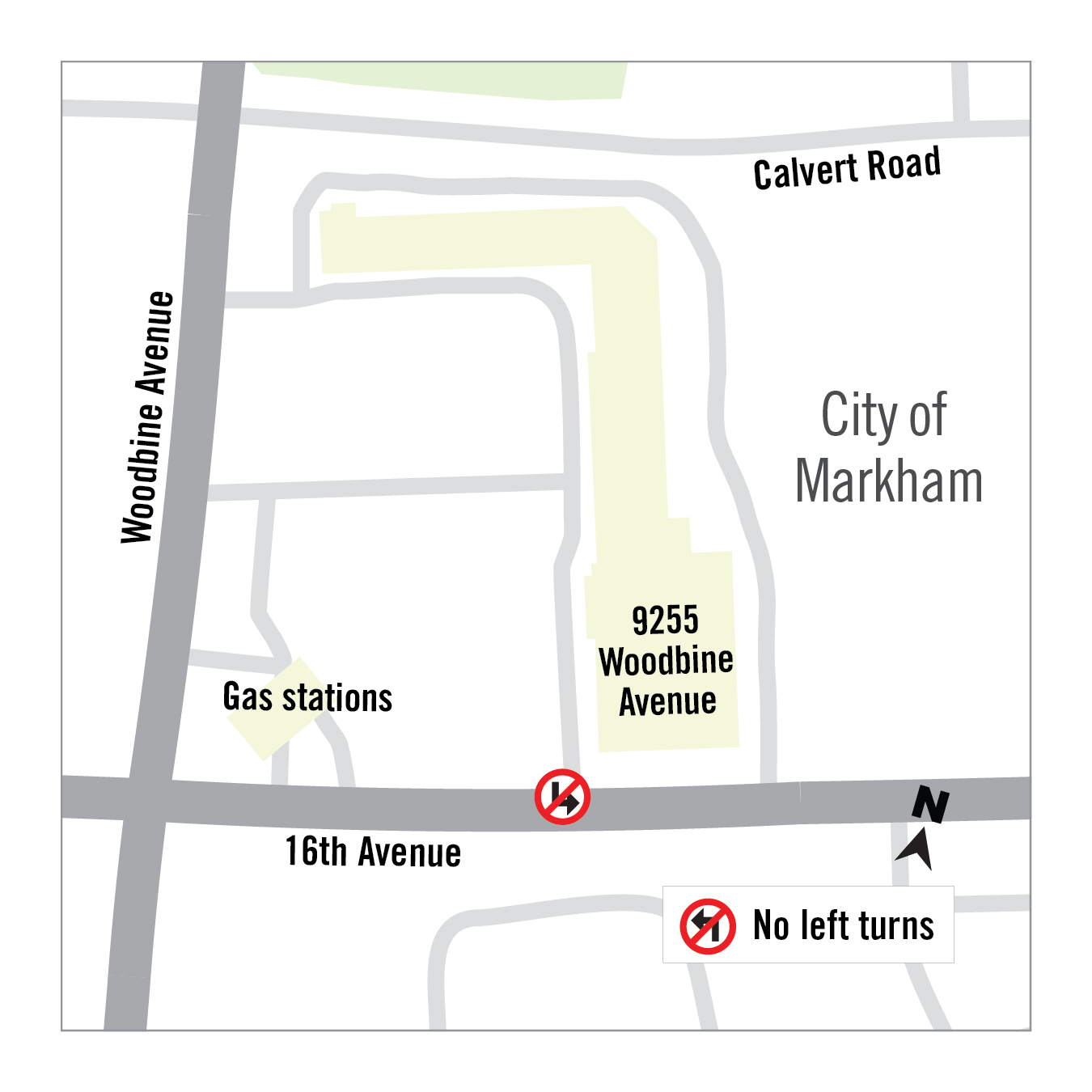
Safety Measure Implemented
- Left-turn restriction from 9255 Woodbine Avenue onto 16th Avenue
Frequently Asked Questions
Why were these safety measures implemented?
One of York Region’s top priorities is to reduce the number and severity of collisions that happen on Regional roads. Safety information and data are reviewed annually, and based on the results, improvements are made across the Region. This could include making improvements to existing roads and intersections, improving the design of new roads, law enforcement and raising public awareness.
The left-turn restriction addresses a rise in collisions involving southbound vehicles turning left from the plaza and improves safety for all road users, as outlined in York Region’s Vision Zero Traveller Safety Plan.
When will these safety measures be implemented?
The left-turn restriction will be implemented in spring 2026.
How will these safety measures be enforced?
York Regional Police will enforce.
How was this plan shared with the community?
York Region mailed letters to area residents and businesses, provided information on york.ca and promoted on social media.
Black River Road and Park Road
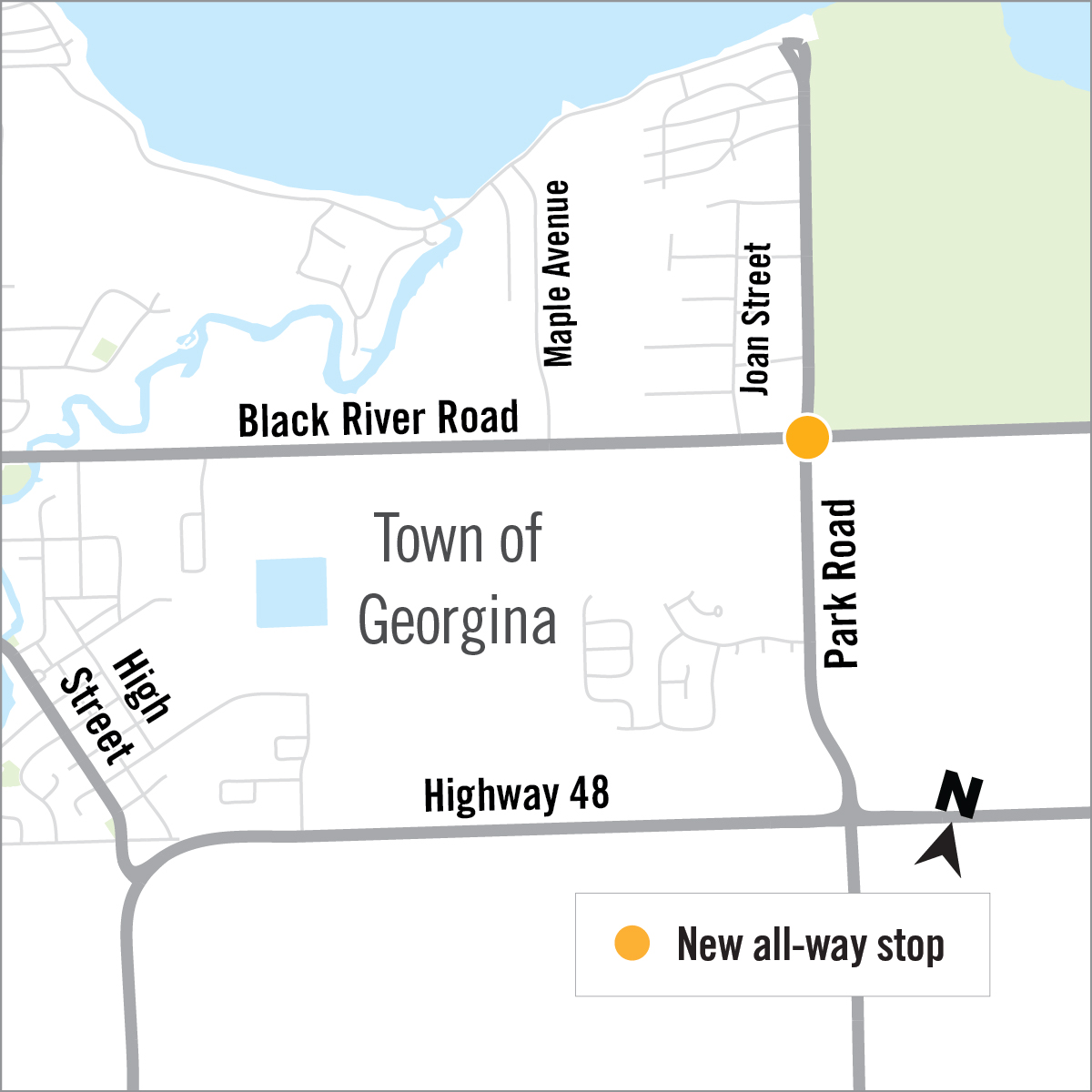
Safety Measure Implemented
- Upgrading the intersection from a two-way stop to an all-way stop
Frequently Asked Questions
Why was this safety measure implemented?
One of York Region’s top priorities is to reduce the number and severity of collisions that happen on Regional roads. Safety information and data are reviewed annually, and based on the results, improvements are made across the Region. This could include making improvements to existing roads and intersections, improving the design of new roads, law enforcement and raising public awareness.
As outlined in York Region’s Vision Zero Traveller Safety Plan, all-way stops help reduce collisions, improve visibility and enhance the safety of all road users.
When will this safety measure be implemented?
The all-way stop will be implemented in June 2026.
How will this safety measure be enforced?
York Regional Police will enforce.
How was this plan shared with the community?
York Region mailed postcards to area residents, provided information on york.ca and promoted on social media.
Highway 7 and Langstaff Road
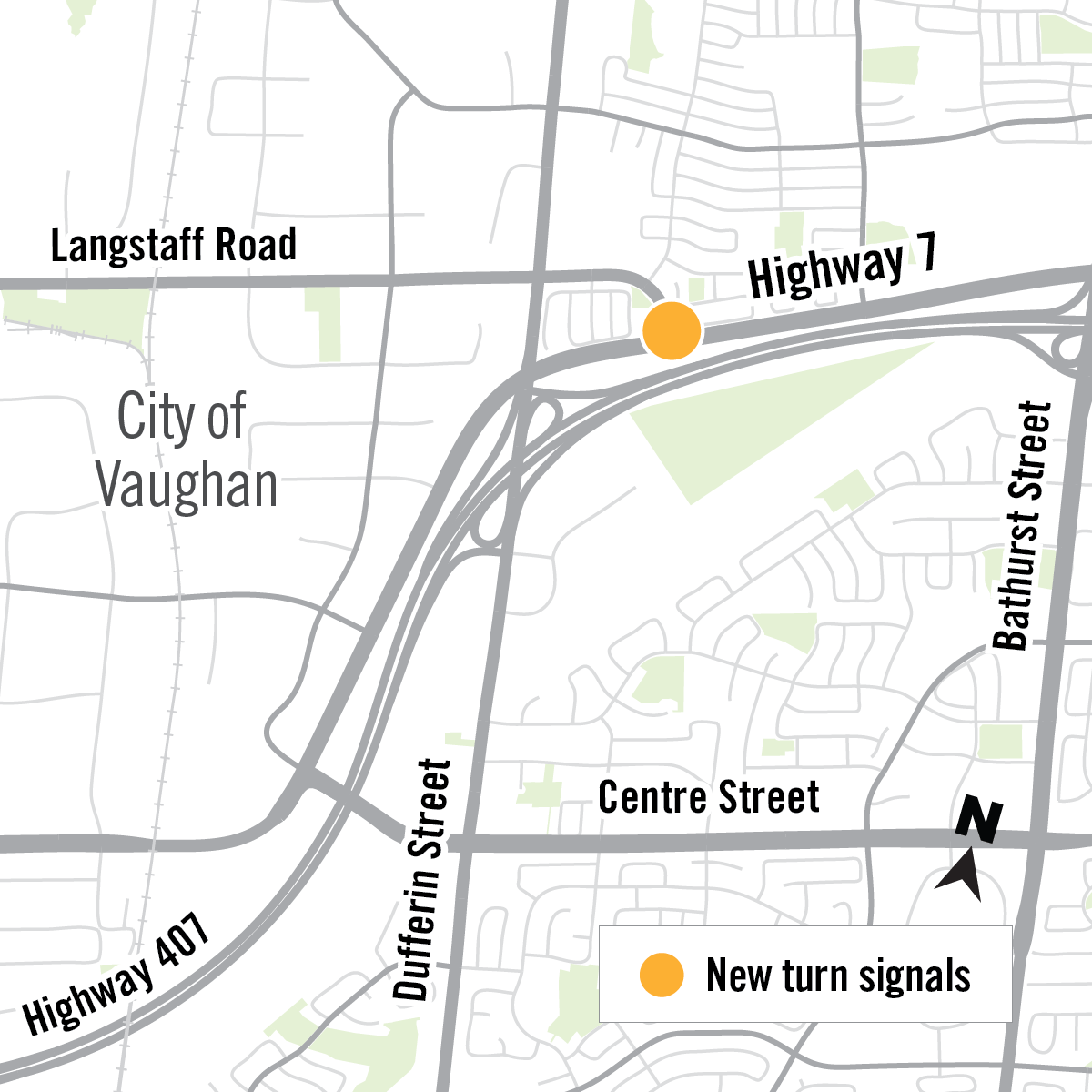
Safety Measures Implemented
- A new eastbound left turn signal allowing drivers to turn left only on a green arrow
- A new southbound right turn signal allowing drivers to turn right during the eastbound left turn signal
Frequently Asked Questions
Why were these safety measures implemented?
One of York Region’s top priorities is to reduce the number and severity of collisions that happen on Regional roads. Safety information and data are reviewed annually, and based on the results, improvements are made across the Region. This could include making improvements to existing roads and intersections, improving the design of new roads, law enforcement and raising public awareness.
Why were the new turn signals implemented at this intersection?
As outlined in York Region’s Vision Zero Traveller Safety Plan, these improvements improve traffic flow and safety of all road users.
When will these safety measures be implemented?
The new safety measures will be implemented in spring 2026.
How will these safety measures be enforced?
York Regional Police will enforce.
How was this plan shared with the community?
York Region mailed postcards to area residents, provided information on york.ca and promoted on social media.
Highway 7 and McCowan Road
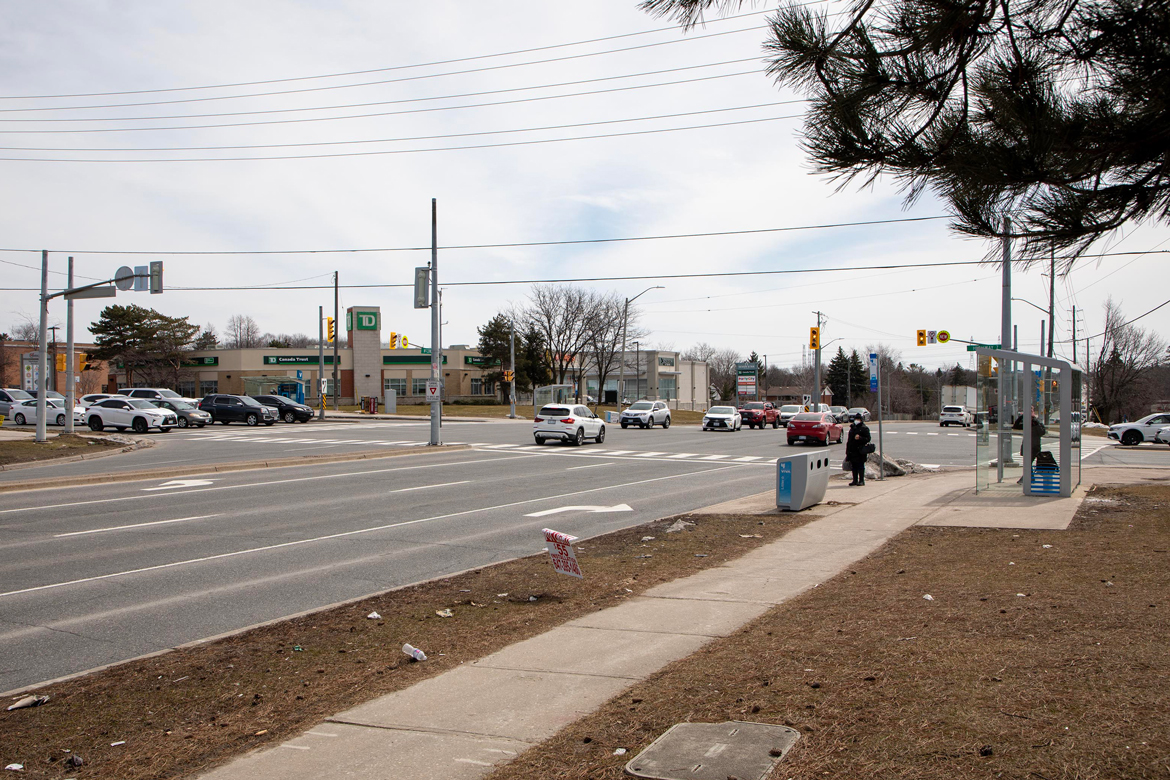
Safety Measures Implemented
- No right turn on red signal for drivers from 7 a.m. to 6 p.m. Monday to Friday
An additional safety measure coming in 2025 includes:
- A fully protected left turn signal for drivers in all directions
Frequently Asked Questions
Why were these safety measures implemented?
One of York Region’s top priorities is to reduce the number and severity of collisions that happen on Regional roads. Safety information and data are reviewed annually, and based on the results, improvements are made across the Region. This could include making improvements to existing roads and intersections, improving the design of new roads, law enforcement and raising public awareness.
Why was the no right turn on red implemented at this intersection?
This intersection ranked first in overall collision locations in Markham based on 2019 to 2021 collision statistics. York Regional Police collision data showed vehicles were not yielding right-of-way for pedestrians and cyclists which resulted in four collisions between 2019 and 2021. Statistics show that right-turning vehicles account for 30% of pedestrian collisions and 50% of cyclist collisions.
Why was the time-of-day feature added to the no right turn on red?
There was a high potential for pedestrian and cyclist collisions due to significant volumes, which was the basis for implementing the time-of-day no right turn on red signal for drivers from 7 a.m. to 6 p.m. Monday to Friday.
When were these safety measures be implemented?
No right turn on red signal was implemented in fall 2022. No right turn on red signal based on the time of day was implemented in June 2023.
How will these safety measures be enforced?
York Regional Police will enforce.
How was this plan shared with the community?
York Region provided information on york.ca, mailed postcards to the Markham community and promoted on social media.
Why will the new left-turn signal be added to this intersection in 2025?
To further protect pedestrians, students and cyclists from turning vehicles. Statistics show that left-turning vehicles account for 36% of pedestrian collisions and 14% of cyclist collisions.
Keele Street and Rutherford Road
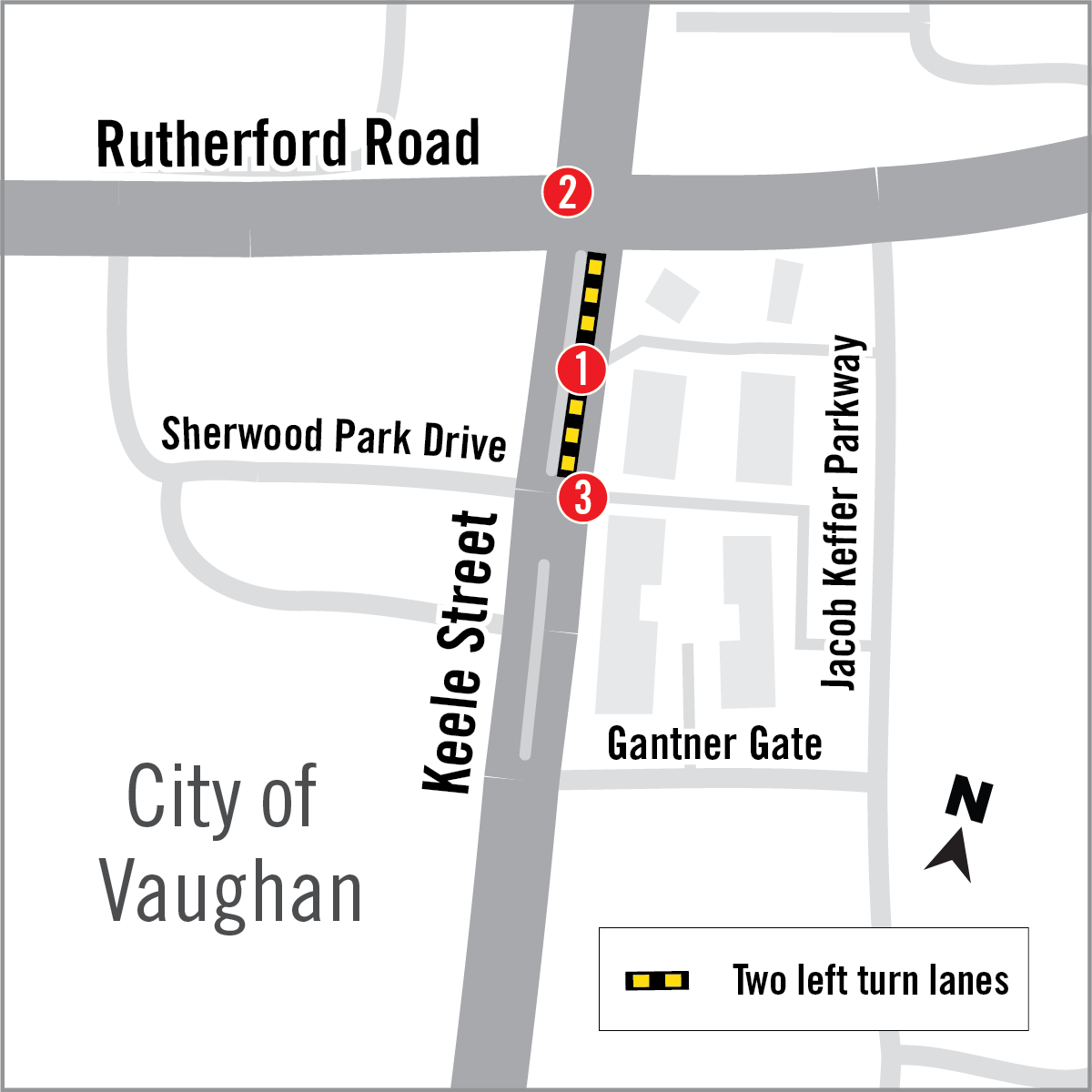
Safety Measures Implemented
- Shifting the median on Keele Street south of Rutherford Road, at Sherwood Park Drive to the west, making space for more vehicles in the northbound left turning lanes
- Removing the No Right on Red restriction for southbound vehicles turning onto Rutherford Road from Keele Street
- Implementing a left turn restriction for southbound vehicles into the commercial business entrance on Keele Street at Sherwood Park Drive
Frequently Asked Questions
Why are these safety measures being implemented?
One of York Region’s top priorities is to reduce the number and severity of collisions that happen on Regional roads. Safety information and data are reviewed annually, and based on the results, improvements are made across the Region. This could include making improvements to existing roads and intersections, improving the design of new roads, law enforcement and raising public awareness.
When are these safety measures be implemented?
The safety measures will be implemented in fall 2025.
How will these safety measures be enforced?
York Regional Police will enforce.
How was this plan shared with the community?
Information is mailed to area residents, posted on york.ca, promoted on social media and signage around the intersection.
Major Mackenzie Drive and Hill Street
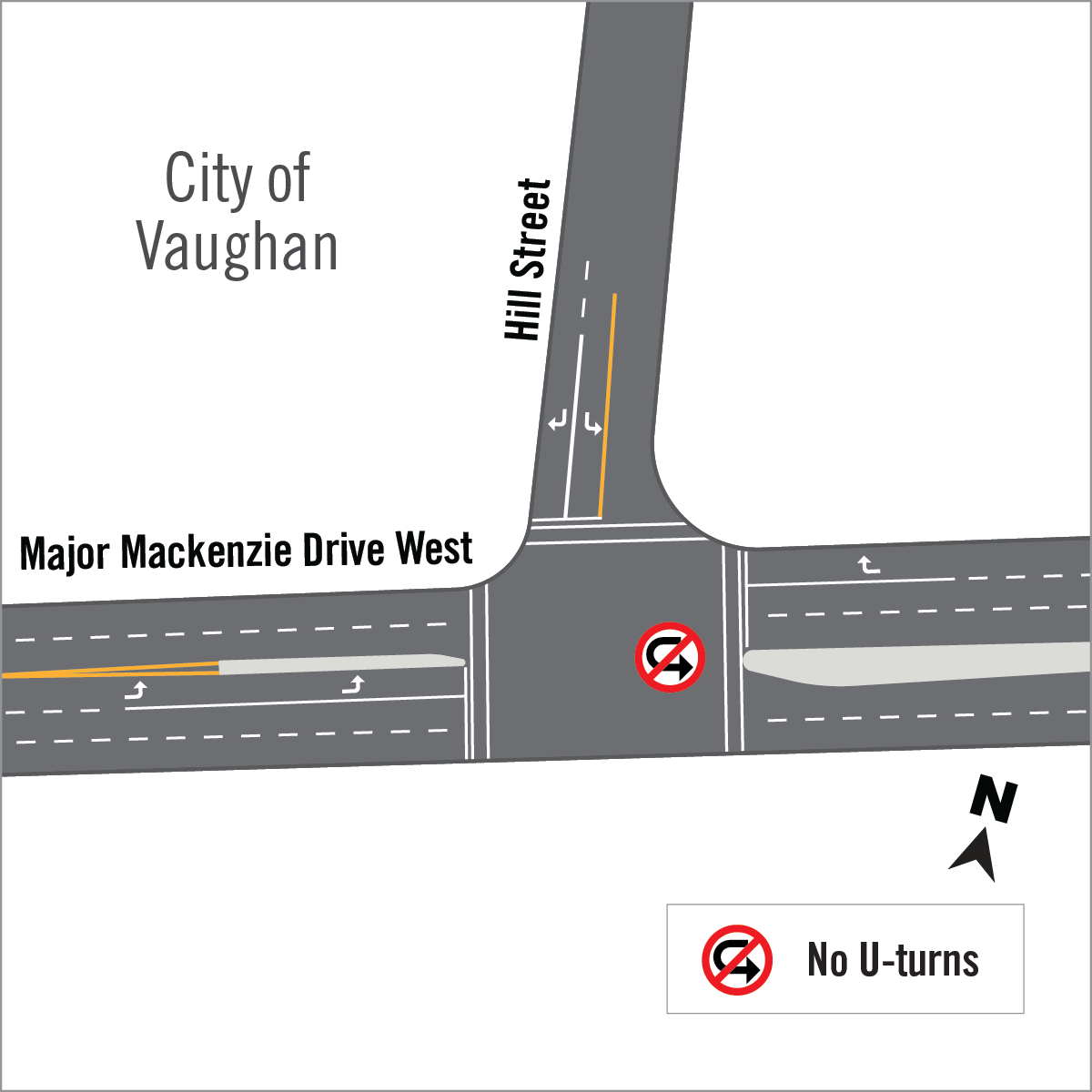
Safety Measures Implemented
- Westbound U-turn restriction at the intersection of Major Mackenzie Drive and Hill Street
Frequently Asked Questions
Why were these safety measures implemented?
One of York Region’s top priorities is to reduce the number and severity of collisions that happen on Regional roads. Safety information and data are reviewed annually, and based on the results, improvements are made across the Region. This could include making improvements to existing roads and intersections, improving the design of new roads, law enforcement and raising public awareness.
This restriction improves traveller safety at the intersection.
When will these safety measures be implemented?
The U-turn restriction will be implemented in February 2026.
How will these safety measures be enforced?
York Regional Police will enforce.
How was this plan shared with the community?
York Region provided information on york.ca
Major Mackenzie Drive East and Church Street South
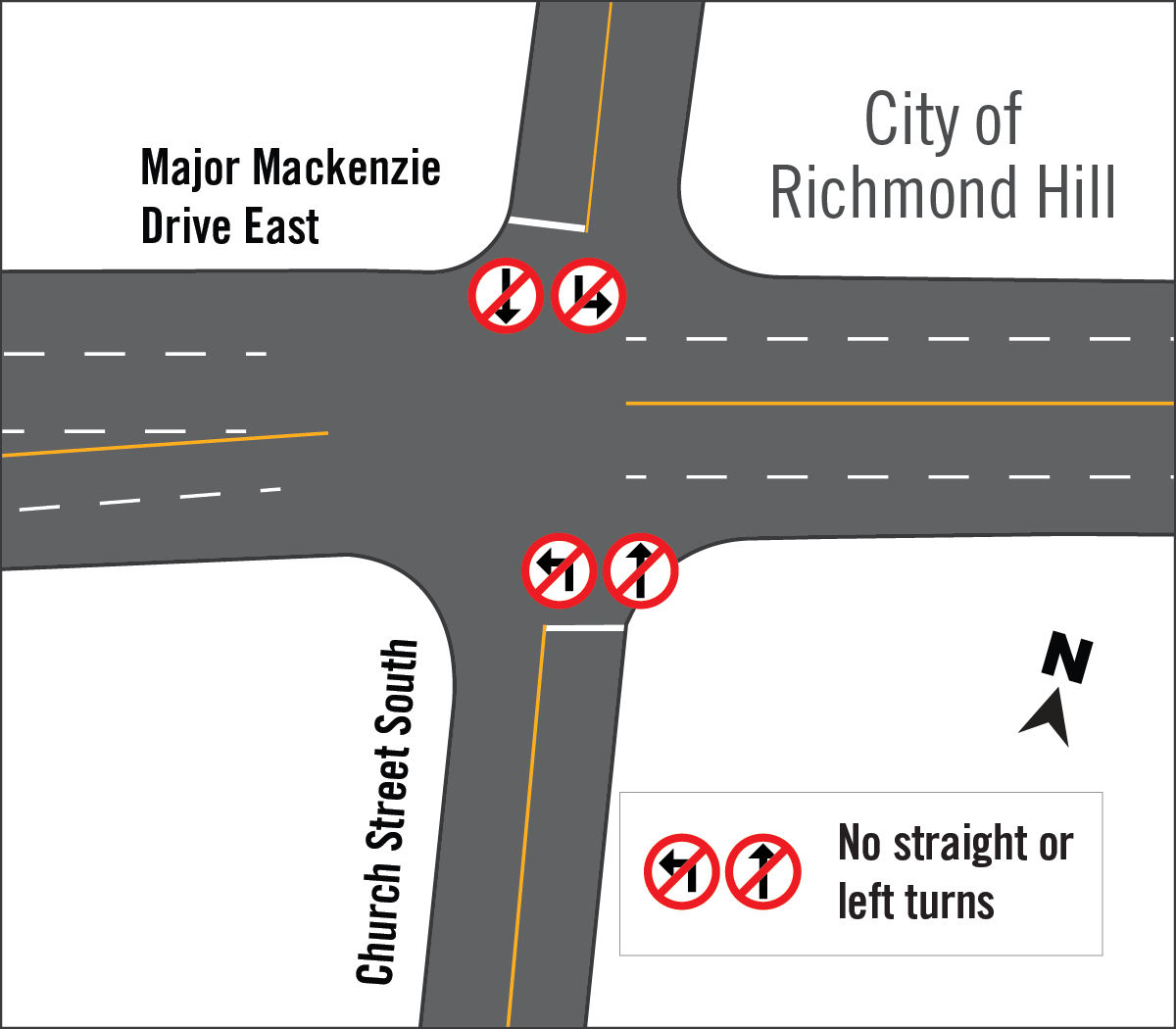
Safety Measures Implemented
- No straight or left turn restrictions for northbound and southbound traffic at the intersection of Major Mackenzie Drive East and Church Street South in the City of Richmond Hill
Frequently Asked Questions
Why were these safety measures implemented?
One of York Region’s top priorities is to reduce the number and severity of collisions that happen on Regional roads. Safety information and data are reviewed annually, and based on the results, improvements are made across the Region. This could include making improvements to existing roads and intersections, improving the design of new roads, law enforcement and raising public awareness.
Why were the no straight and left turn restrictions implemented at this intersection?
To improve traffic flow and traveller safety at the intersection. This safety initiative supports York Region’s Vision Zero Traveller Safety Plan
When were these safety measures be implemented?
The safety measures will be implemented in June 2025.
How will these safety measures be enforced?
York Regional Police will enforce.
How was this plan shared with the community?
York Region provided information to area residents through a postcard and information is posted on york.ca, promoted on social media and signage around the intersection.
Major Mackenzie Drive East and Forestwood Street
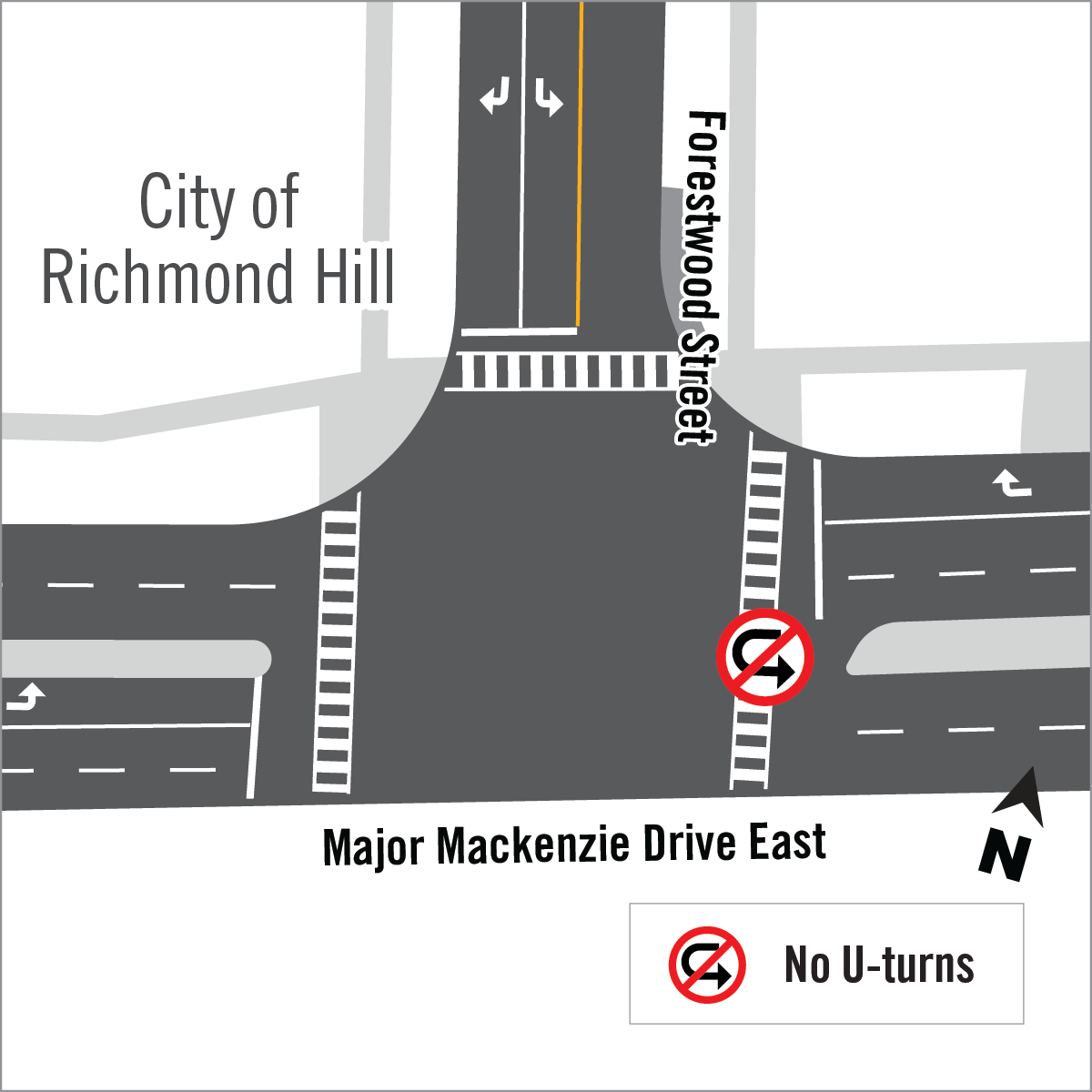
Safety Measure Implemented
- A westbound U-turn restriction at Major Mackenzie Drive East and Forestwood Street
Frequently Asked Questions
Why were these safety measures implemented?
One of York Region’s top priorities is to reduce the number and severity of collisions that happen on Regional roads. Safety information and data are reviewed annually, and based on the results, improvements are made across the Region. This could include making improvements to existing roads and intersections, improving the design of new roads, law enforcement and raising public awareness.
As outlined in York Region’s Vision Zero Traveller Safety Plan, this intersection restriction improves traffic flow and safety for all road users.
When will these safety measures be implemented?
The U-turn restriction will be implemented in April 2026.
How will these safety measures be enforced?
York Regional Police will enforce.
How was this plan shared with the community?
York Region mailed postcards to area residents, provided information on york.ca and promoted on social media.
Major Mackenzie Drive West and Barons Street
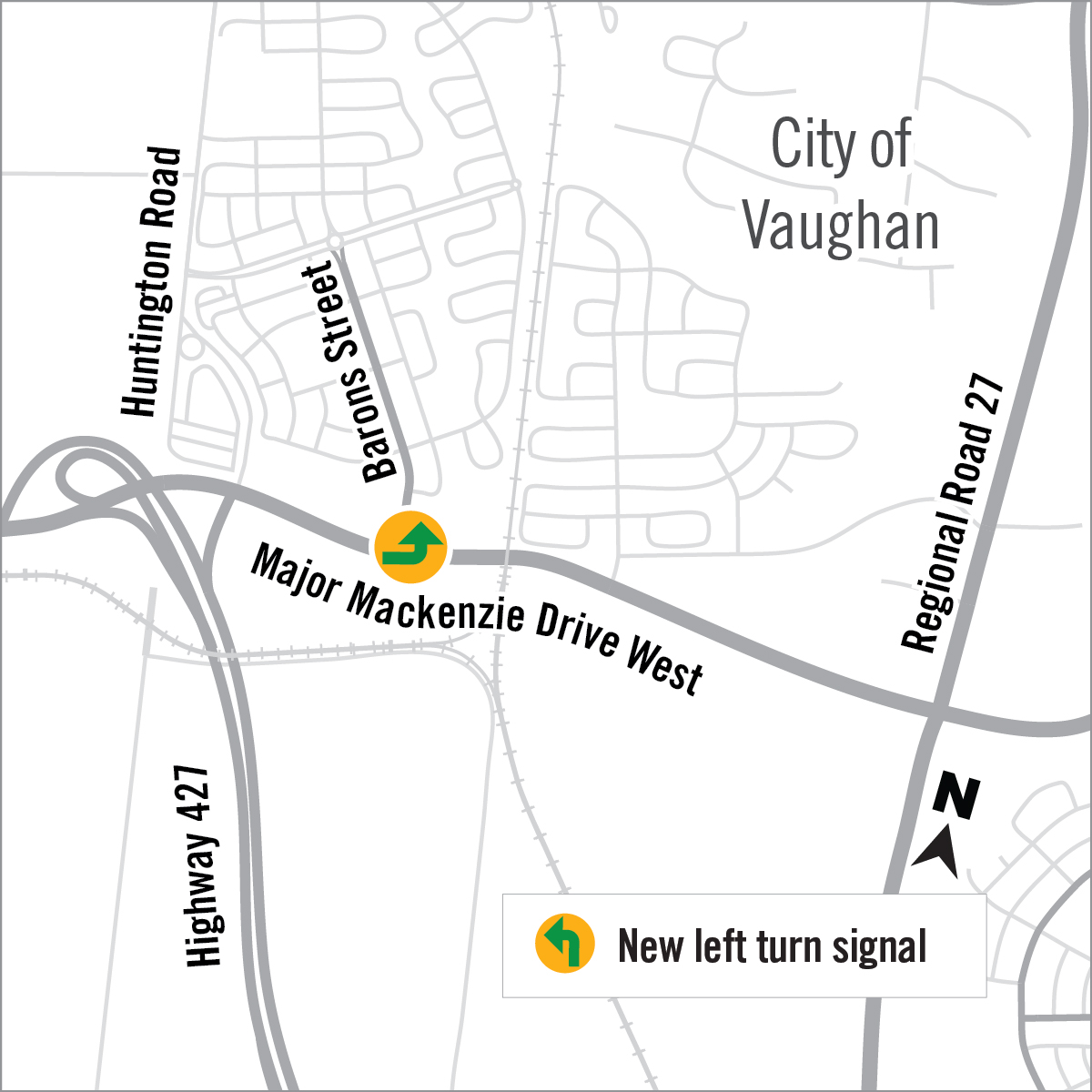
Safety Measure Implemented
- An eastbound protected left turn signal at the intersection of Major Mackenzie Drive West and Barons Street
Frequently Asked Questions
Why were these safety measures implemented?
One of York Region’s top priorities is to reduce the number and severity of collisions that happen on Regional roads. Safety information and data are reviewed annually, and based on the results, improvements are made across the Region. This could include making improvements to existing roads and intersections, improving the design of new roads, law enforcement and raising public awareness.
As outlined in York Region’s Vision Zero Traveller Safety Plan, left turn signals help reduce collisions and enhance the safety of all road users.
When will this safety measure be implemented?
The new protected left turn signal will be implemented in May 2026.
How will this safety measure be enforced?
York Regional Police will enforce.
How was this plan shared with the community?
York Region mailed postcards to area residents, provided information on york.ca and promoted on social media.
Milbourne Lane at Bloomington Road
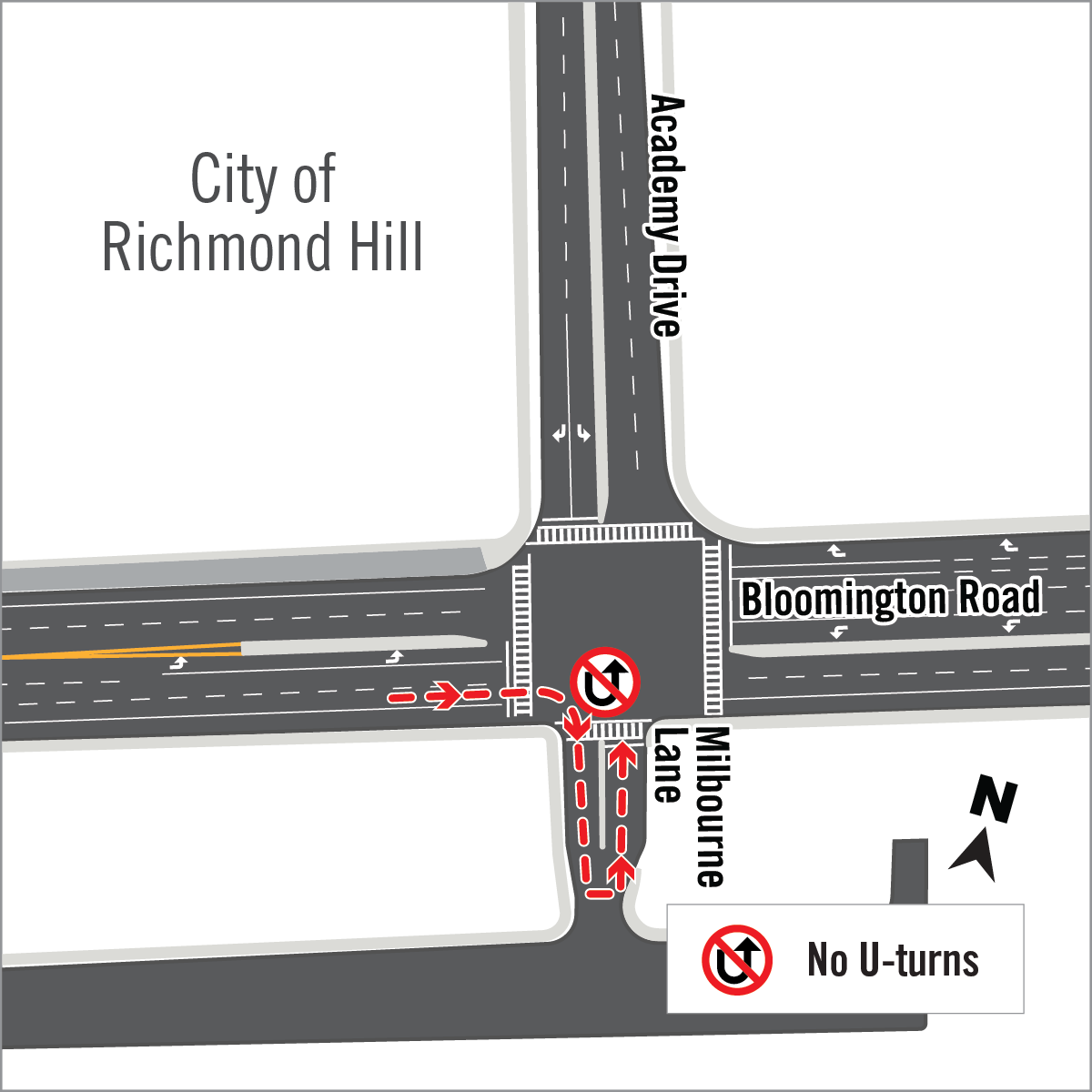
Safety Measures Implemented
- U-turn restriction on Milbourne Lane at Bloomington Road
Frequently Asked Questions
Why were these safety measures implemented?
One of York Region’s top priorities is to reduce the number and severity of collisions that happen on Regional roads. Safety information and data are reviewed annually, and based on the results, improvements are made across the Region. This could include making improvements to existing roads and intersections, improving the design of new roads, law enforcement and raising public awareness.
As outlined in York Region’s Vision Zero Traveller Safety Plan, this restriction improves traffic flow and safety for all road users.
When will these safety measures be implemented?
The U-turn restriction will be implemented in spring 2026.
How will these safety measures be enforced?
York Regional Police will enforce.
How was this plan shared with the community?
York Region mailed postcards to area residents, provided information on york.ca and promoted on social media.
Mulock Drive and Fernbank Road/College Manor Drive
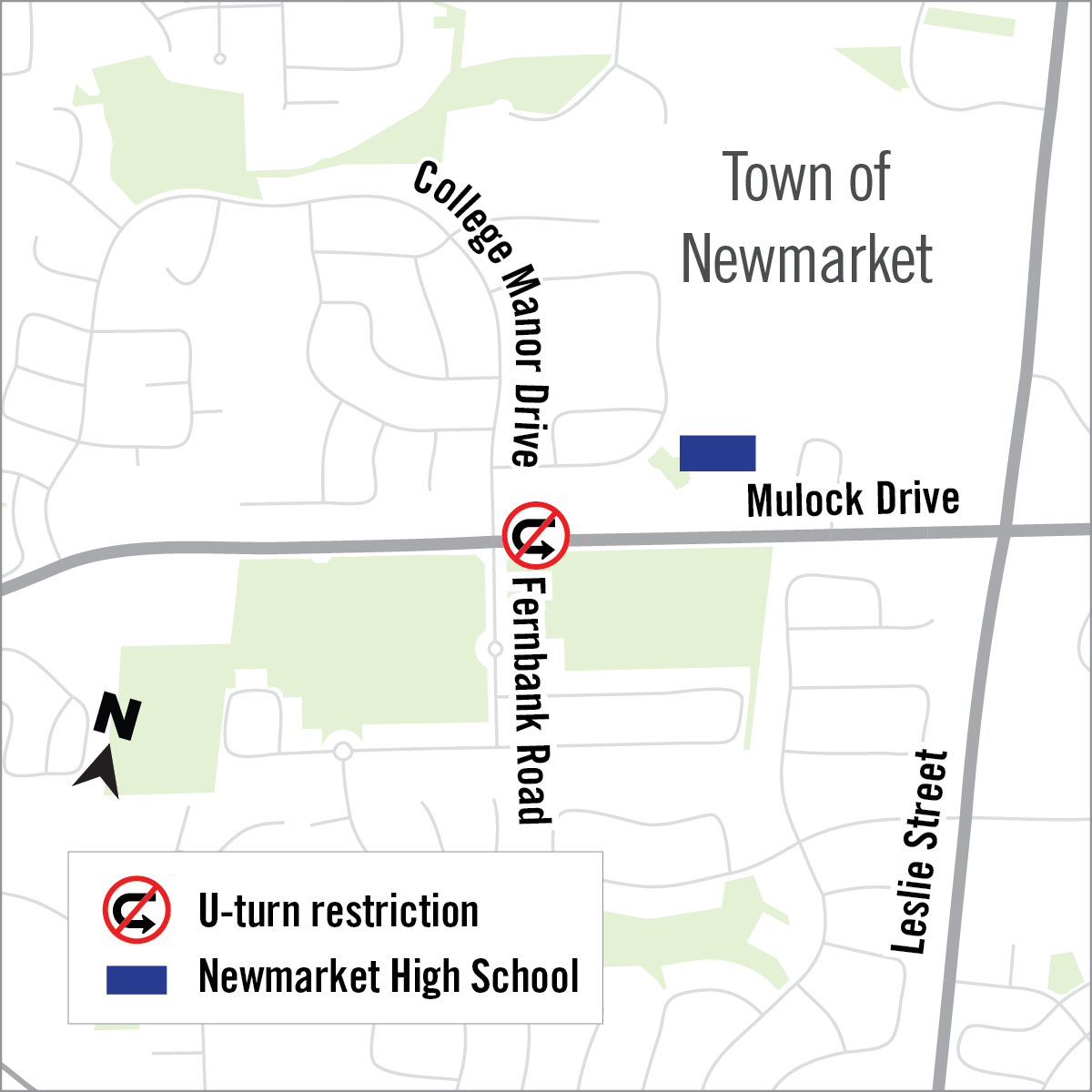
Safety Measures Implemented
- A westbound U-turn restriction at the intersection of Mulock Drive and Fernbank Road/College Manor Drive, near Newmarket High School
Frequently Asked Questions
Why were these safety measures implemented?
One of York Region’s top priorities is to reduce the number and severity of collisions that happen on Regional roads. Safety information and data are reviewed annually, and based on the results, improvements are made across the Region. This could include making improvements to existing roads and intersections, improving the design of new roads, law enforcement and raising public awareness.
Why was a U-turn restriction implemented at this intersection?
More than 40 westbound U-turns occur daily at this intersection, with almost 450 northbound right turning motorists. There are 7,000 eastbound vehicles travelling through the intersection and 350 pedestrians crossing east. Newmarket High School is located east of the intersection, contributing to the significant pedestrian volumes. Implementing this restriction helps improve safety and protects vulnerable road users.
When were these safety measures implemented?
The safety measures were implemented the week of January 6, 2025.
How will these safety measures be enforced?
York Regional Police will enforce.
How was this plan shared with the community?
York Region provided information on york.ca, mailed postcards to area residents, promoted on social media and signage around the intersections.
Nashville Road and Cold Creek Road
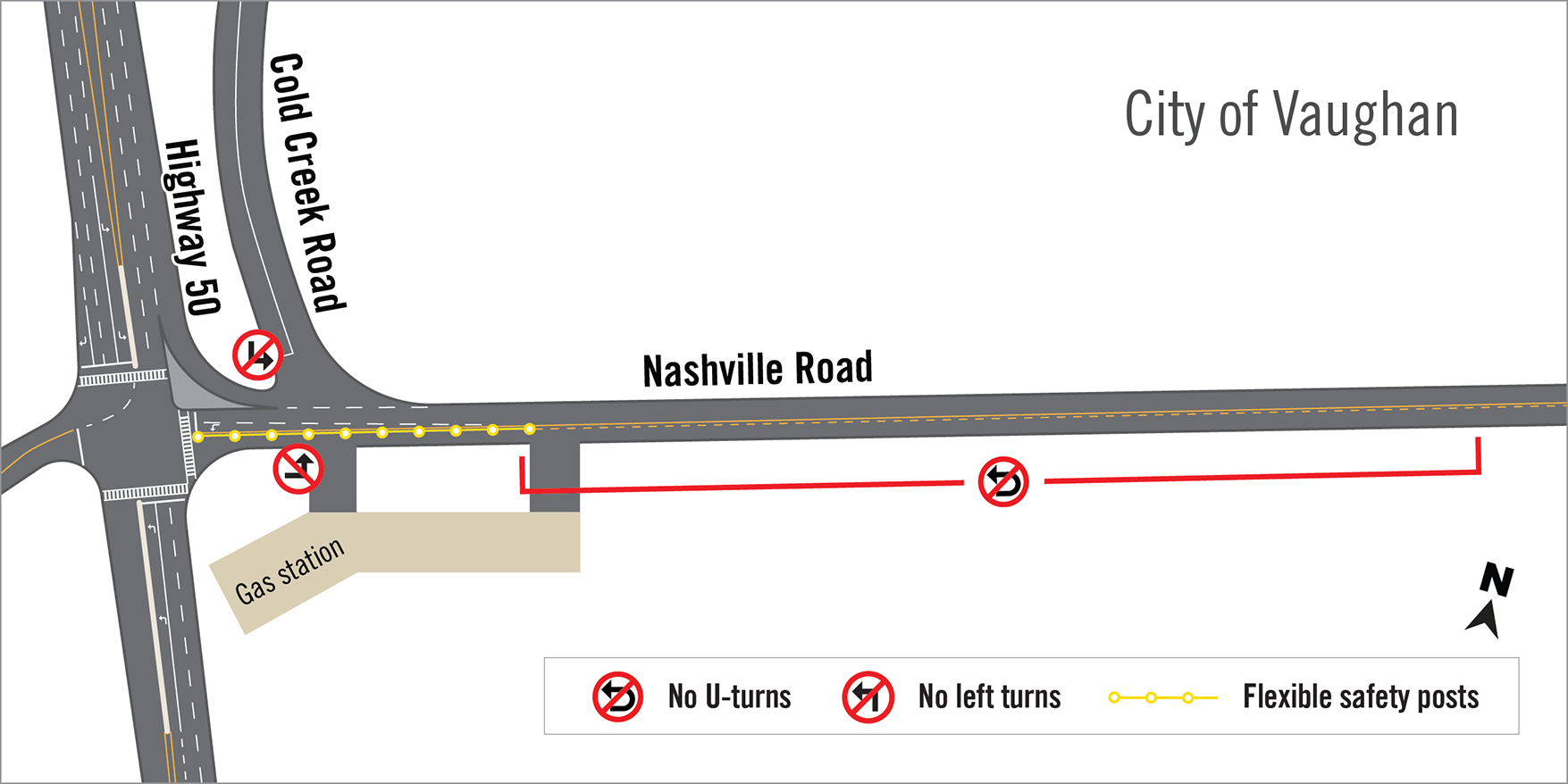
Safety Measures Implemented
- Restricted left turns at the intersection:
- No left turns from Cold Creek Road southbound to Nashville Road eastbound
- No left turns from Nashville Road eastbound to Cold Creek Road northbound
- Flexible safety posts to reinforce the restrictions
- Eastbound U-turn restriction on Nashville Road from Cold Creek Road to 325 metres east of the intersection
Frequently Asked Questions
Why were these safety measures implemented?
One of York Region’s top priorities is to reduce the number and severity of collisions that happen on Regional roads. Safety information and data are reviewed annually, and based on the results, improvements are made across the Region. This could include making improvements to existing roads and intersections, improving the design of new roads, law enforcement and raising public awareness.
As outlined in York Region’s Vision Zero Traveller Safety Plan, these improvements enhance the safety of all road users.
When will these safety measures be implemented?
The restricted left turns at the intersection were implemented in October 2025. The eastbound U-turn restriction will be implemented in February 2026.
How will these safety measures be enforced?
York Regional Police will enforce.
How was this plan shared with the community?
York Region mailed postcards to area residents, provided information on york.ca and promoted on social media.
Old Homestead Road and Metro Road
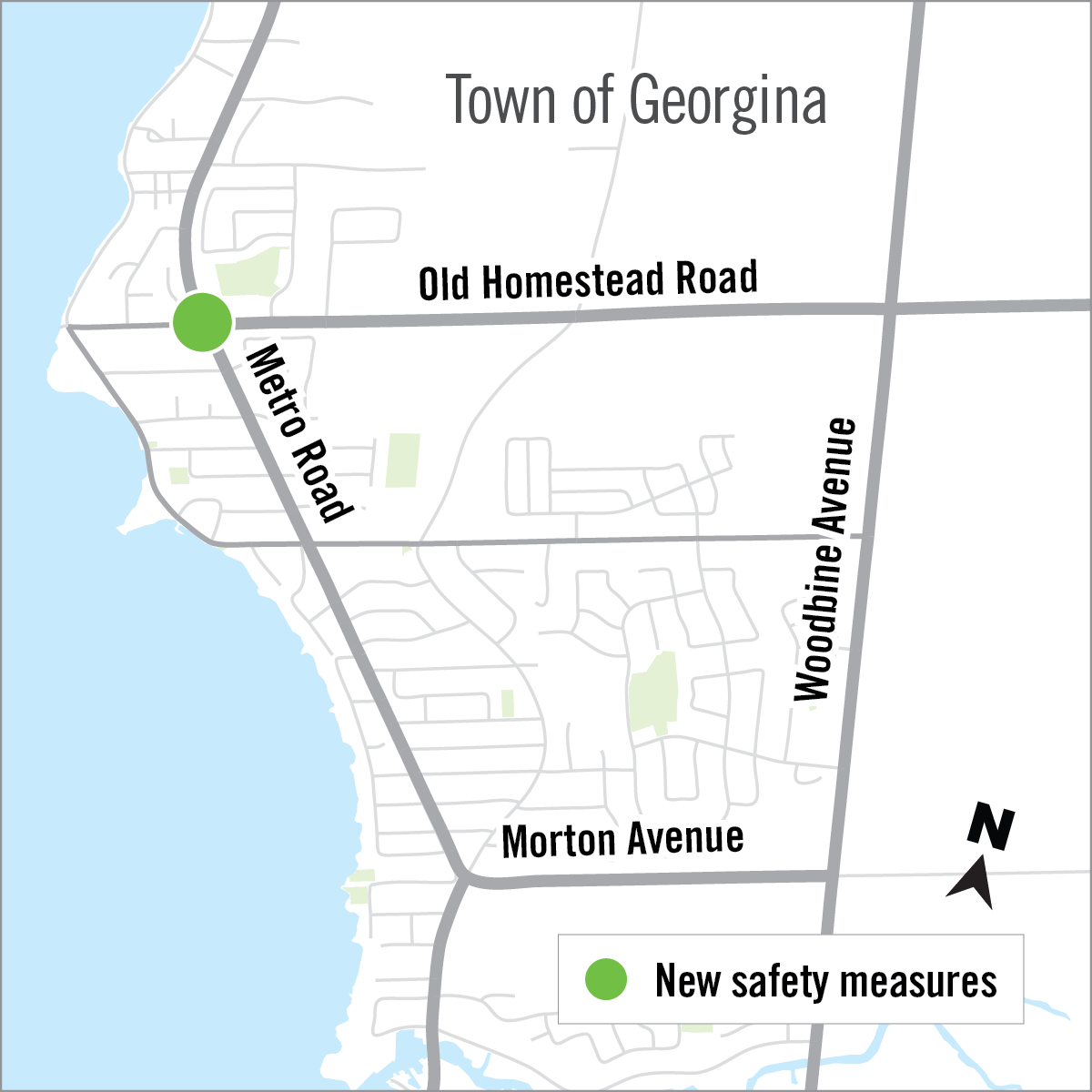
Safety Measures Implemented
- Extending sidewalk curbs through pavement markings to reduce speeding and increase safety for students crossing at the intersection
- Installing an overhead intersection flashing light to improve visibility of the intersection and reinforce existing stop signs
Frequently Asked Questions
Why were these safety measures implemented?
One of York Region’s top priorities is to reduce the number and severity of collisions that happen on Regional roads. Safety information and data are reviewed annually, and based on the results, improvements are made across the Region. This could include making improvements to existing roads and intersections, improving the design of new roads, law enforcement and raising public awareness.
Why were the new left turn signals implemented at this intersection?
As outlined in York Region’s Vision Zero Traveller Safety Plan, these improvements enhance the safety of all road users.
When will these safety measures be implemented?
The new safety measures will be implemented in August 2025.
How will these safety measures be enforced?
York Regional Police will enforce.
How was this plan shared with the community?
York Region mailed postcards to area residents, provided information on york.ca and promoted on social media.
Rutherford Road and Sweet River Boulevard and Rutherford Road and Julliard Drive
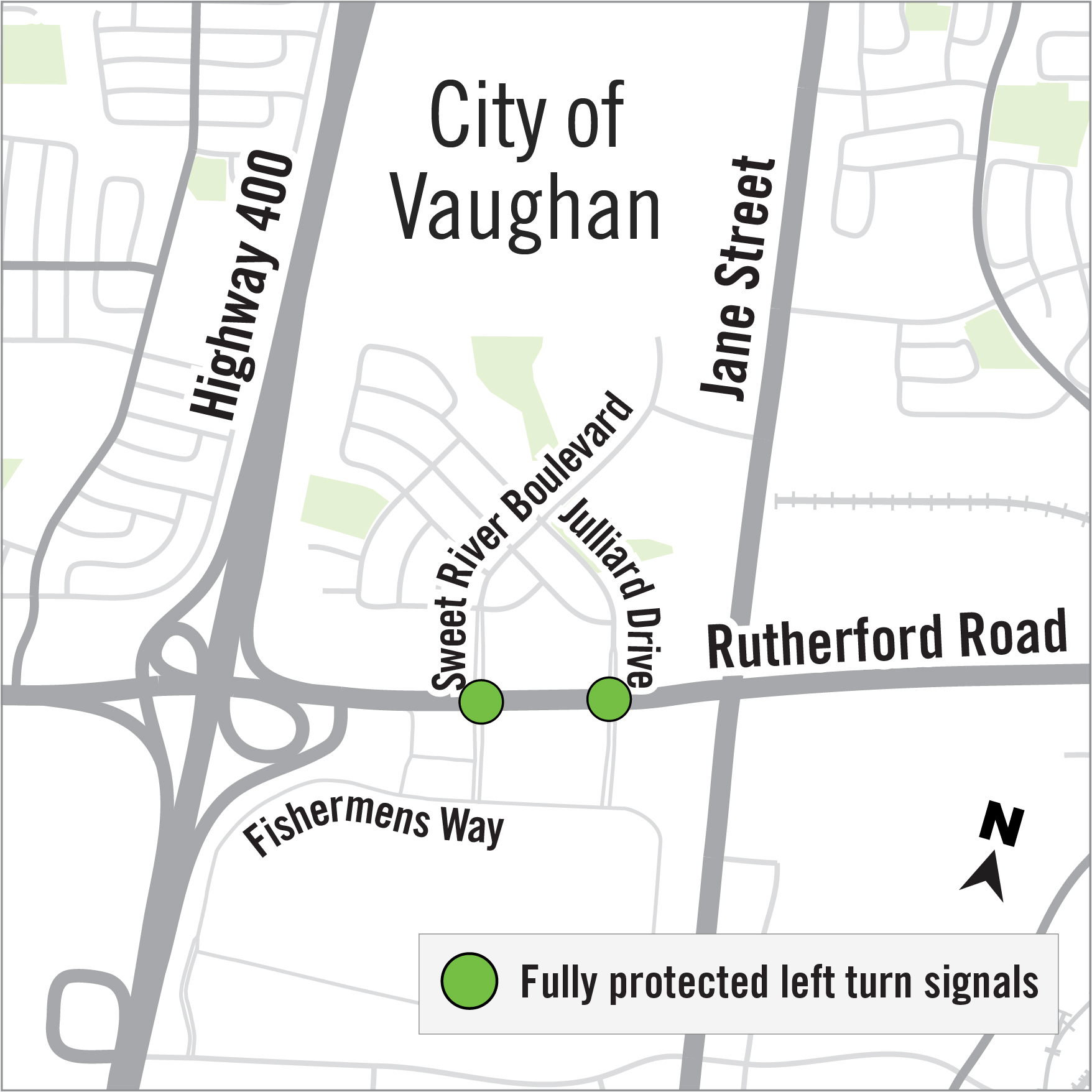
Safety Measures Implemented
- New fully protected westbound left turn signals at:
- Rutherford Road and Sweet River Boulevard
- Rutherford Road and Julliard Drive
Frequently Asked Questions
Why were these safety measures implemented?
One of York Region’s top priorities is to reduce the number and severity of collisions that happen on Regional roads. Safety information and data are reviewed annually, and based on the results, improvements are made across the Region. This could include making improvements to existing roads and intersections, improving the design of new roads, law enforcement and raising public awareness.
Why were the protected left turn signals implemented at these intersections?
These intersections are ranked in the top 10 for highest turning incidents in the City of Vaughan. The intersection of Rutherford Road and Sweet River Boulevard is ranked number 2, with 76 collisions, 17 injuries, with two cyclists involved over the past five years. The intersection of Rutherford Road and Julliard Drive is ranked number 8, with 47 collisions and seven injured, with one pedestrian and one cyclist involved.
When were these safety measures implemented?
The safety measures will be implemented in January 2025.
How will these safety measures be enforced?
York Regional Police will enforce.
How was this plan shared with the community?
York Region provided information on york.ca, promoted on social media and signage around the intersections.
Stouffville Road and Bridgewater Drive
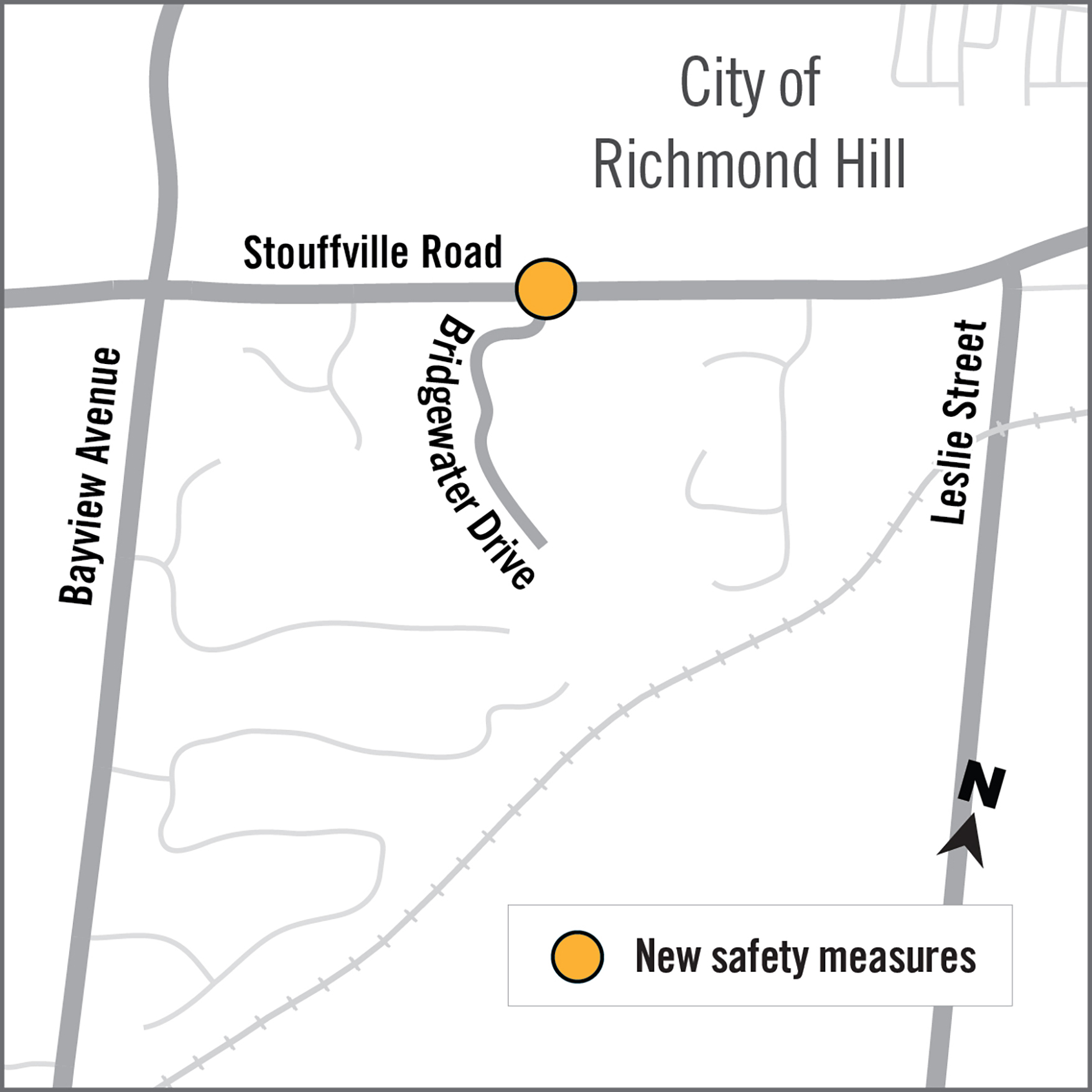
Safety Measures Implemented
- Installing speed reduction pavement markings and an overhead intersection flashing light to encourage drivers to slow down
- Relocating the stop bar pavement marking and stop sign to increase visibility
Frequently Asked Questions
Why were these safety measures implemented?
One of York Region’s top priorities is to reduce the number and severity of collisions that happen on Regional roads. Safety information and data are reviewed annually, and based on the results, improvements are made across the Region. This could include making improvements to existing roads and intersections, improving the design of new roads, law enforcement and raising public awareness.
When will these safety measures be implemented?
The new safety measures will be implemented in fall 2025.
How will these safety measures be enforced?
York Regional Police will enforce.
How was this plan shared with the community?
York Region mailed postcards to area residents, provided information on york.ca and promoted on social media.
St John’s Sideroad and Willow Farm Lane
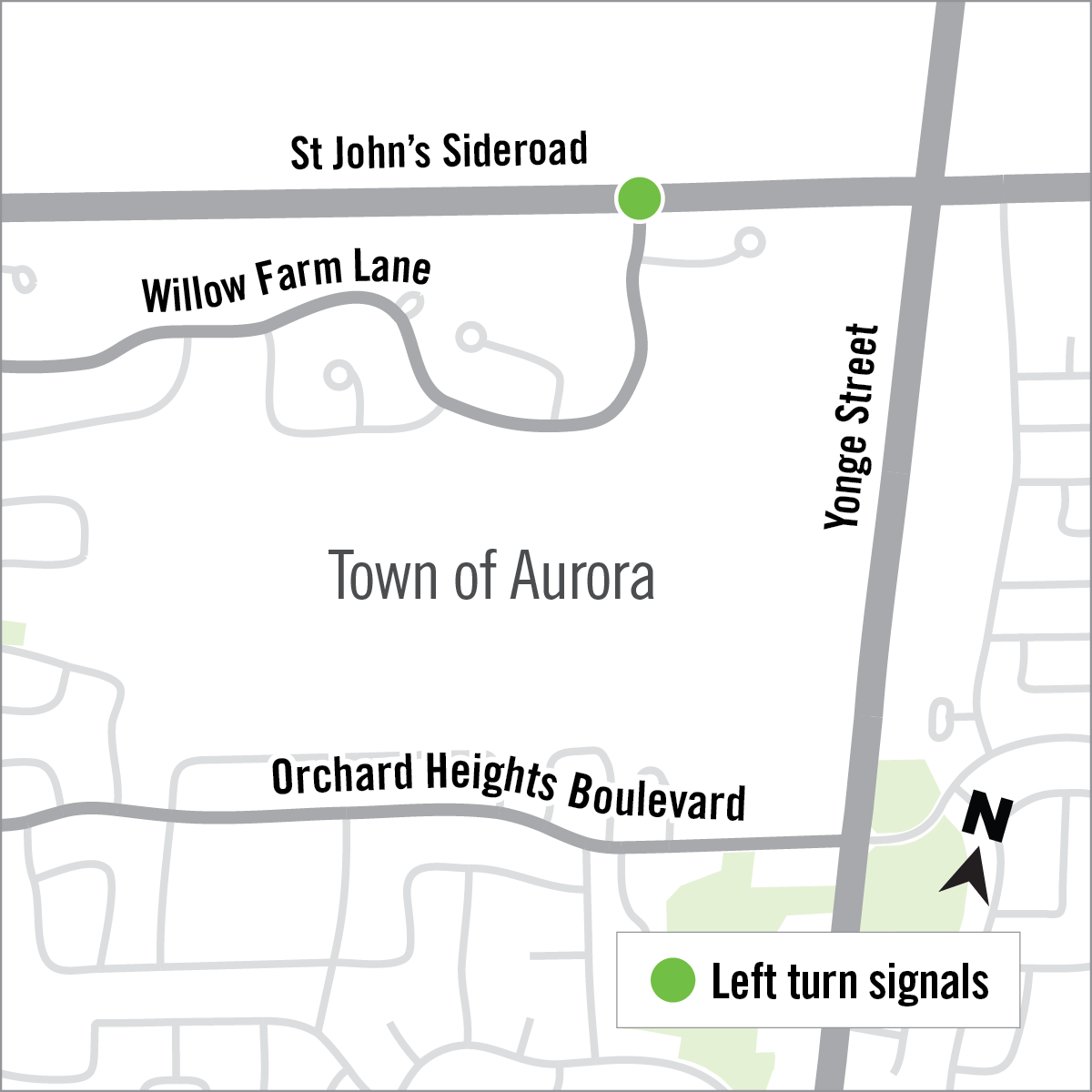
Safety Measures Implemented
- A new eastbound left turn signal allowing drivers to turn left only on a green arrow
- A new westbound left turn signal allowing drivers to turn left during a green arrow and a green light when it’s safe to do so
Frequently Asked Questions
Why were these safety measures implemented?
One of York Region’s top priorities is to reduce the number and severity of collisions that happen on Regional roads. Safety information and data are reviewed annually, and based on the results, improvements are made across the Region. This could include making improvements to existing roads and intersections, improving the design of new roads, law enforcement and raising public awareness.
Why were the new left turn signals implemented at this intersection?
As outlined in York Region’s Vision Zero Traveller Safety Plan, new left turn signals help reduce collisions and enhance the safety of all road users.
When will these safety measures be implemented?
The new left turn signals will be implemented in August 2025.
How will these safety measures be enforced?
York Regional Police will enforce.
How was this plan shared with the community?
York Region mailed postcards to area residents, provided information on york.ca and promoted on social media.
Warden Avenue and Enterprise Boulevard
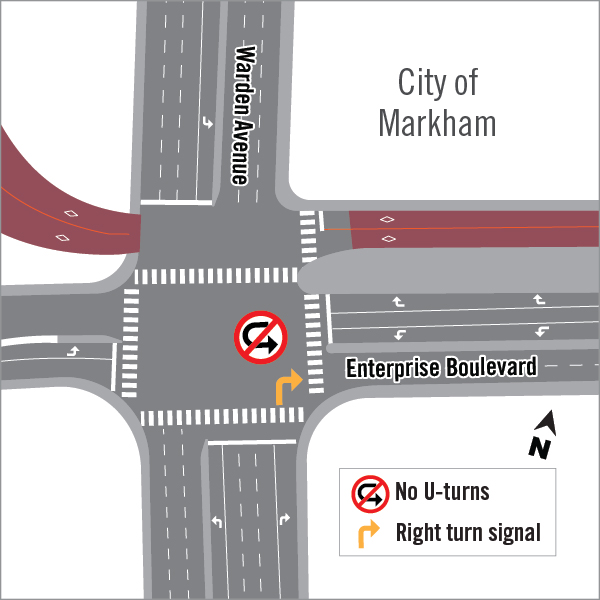
Safety Measures Implemented
- A westbound U-turn restriction
- A northbound right turn signal that activates during the westbound left turn signal
Frequently Asked Questions
Why were these safety measures implemented?
One of York Region’s top priorities is to reduce the number and severity of collisions that happen on Regional roads. Safety information and data are reviewed annually, and based on the results, improvements are made across the Region. This could include making improvements to existing roads and intersections, improving the design of new roads, law enforcement and raising public awareness.
As outlined in York Region’s Vision Zero Traveller Safety Plan, these new measures improve traffic flow and safety for all road users.
When will these safety measures be implemented?
New safety measures will be implemented in summer 2026
How will these safety measures be enforced?
York Regional Police will enforce.
How was this plan shared with the community?
York Region mailed postcards to area residents, provided information on york.ca and promoted on social media.
Woodbine Avenue and Ravenshoe Road
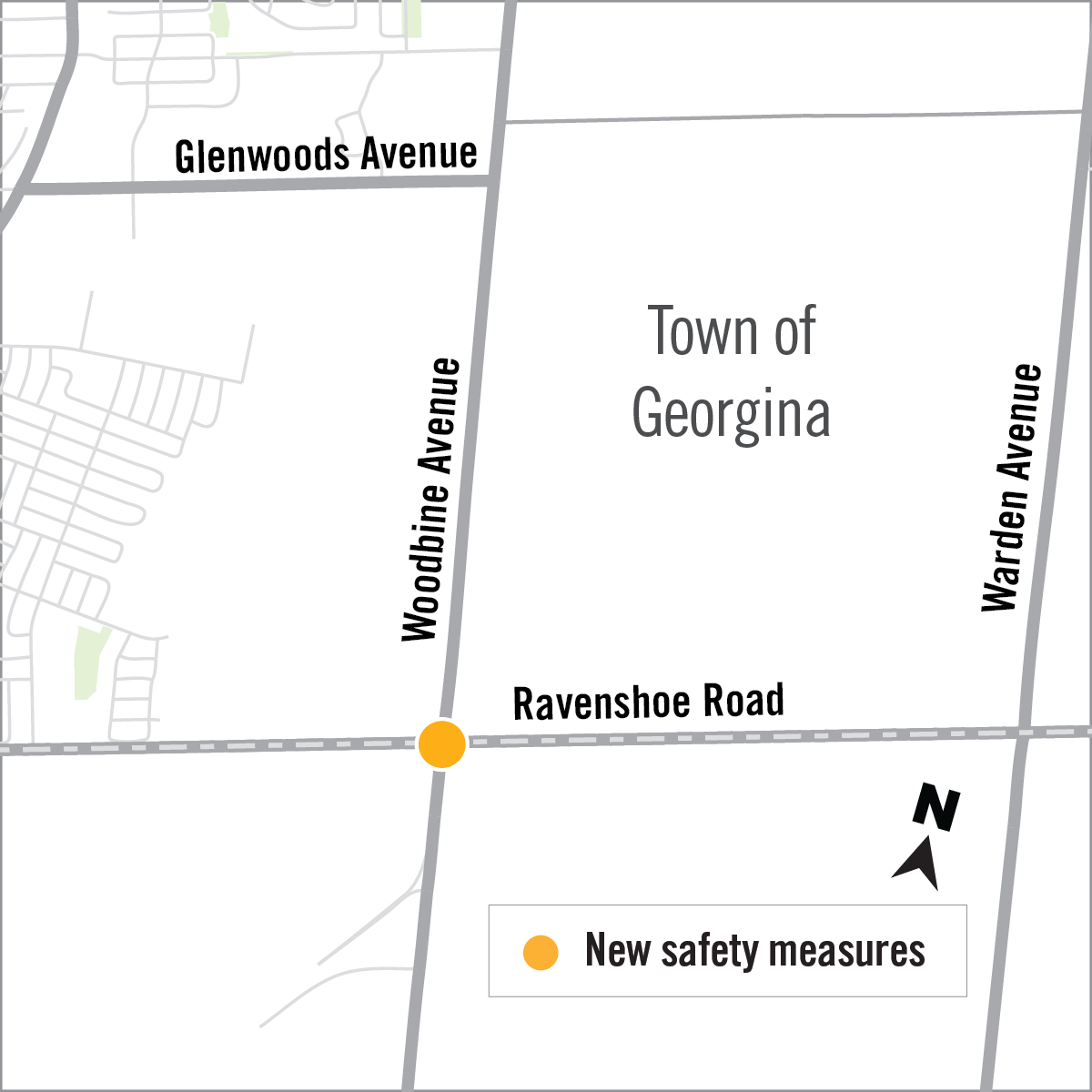
Safety Measures Implemented
- Double left-turn lanes for north and west drivers
- An eastbound right-turn signal, allowing right turns during the northbound left-turn signal
- A digital no right on red sign for southbound right turns, activated during the northbound double left-turn
- A median extension, north of intersection, with flexible posts
Frequently Asked Questions
Why were these safety measures implemented?
One of York Region’s top priorities is to reduce the number and severity of collisions that happen on Regional roads. Safety information and data are reviewed annually, and based on the results, improvements are made across the Region. This could include making improvements to existing roads and intersections, improving the design of new roads, law enforcement and raising public awareness.
As outlined in York Region’s Vision Zero Traveller Safety Plan, these new safety measures help reduce collisions and enhance the safety of all road users.
When will this safety measure be implemented?
The new safety measures will be implemented in late spring to fall 2026.
How will this safety measure be enforced?
York Regional Police will enforce.
How was this plan shared with the community?
York Region mailed postcards to area residents, provided information on york.ca and promoted on social media.
Woodbine Avenue between Mount Albert Road and Green Lane
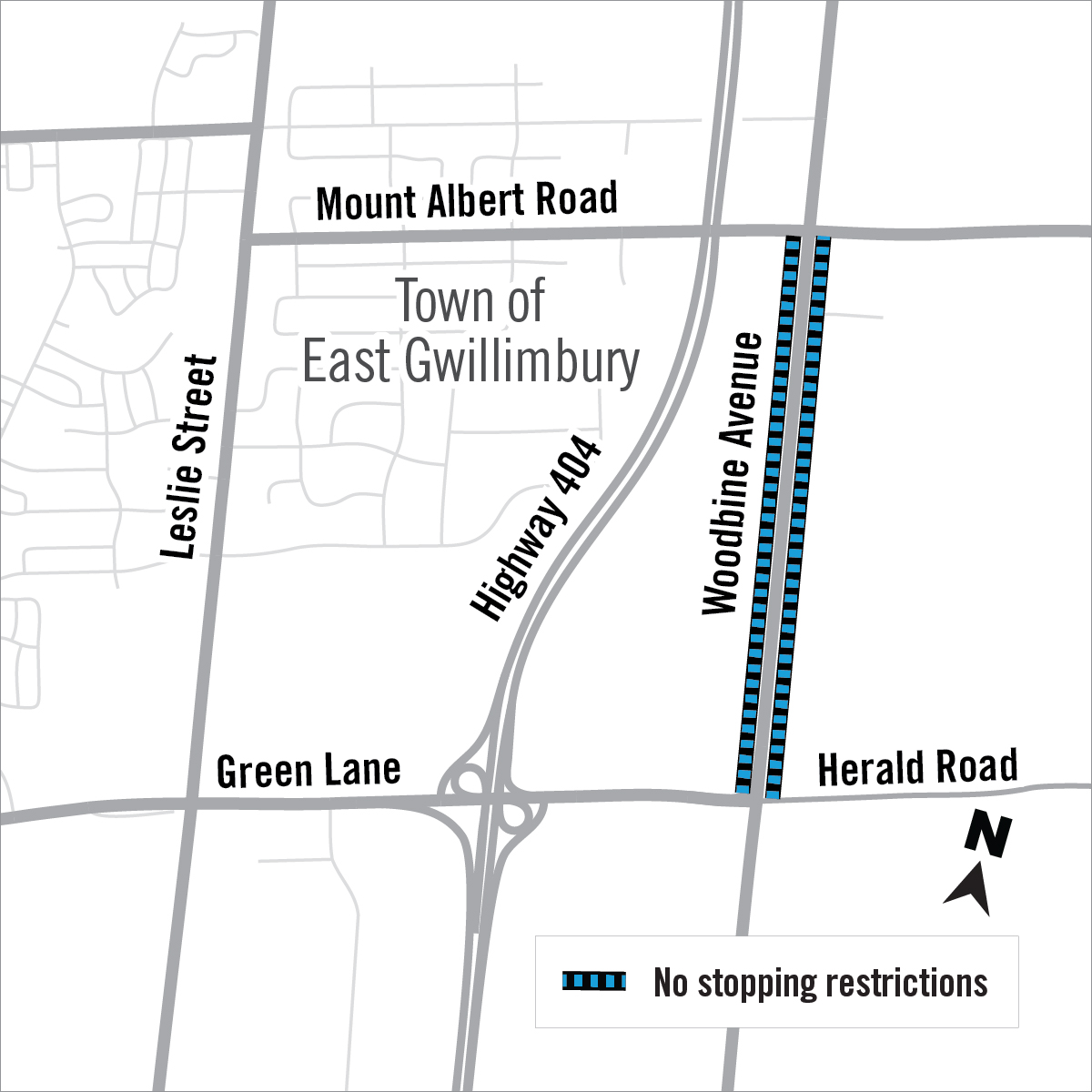
Safety measure implemented
- No stopping restrictions on the east and west side of Woodbine Avenue between Mount Albert Road and Green Lane in the Town of East Gwillimbury
Frequently Asked Questions
Why were these restrictions implemented?
One of York Region’s top priorities is to reduce the number and severity of collisions that happen on Regional roads. Safety information and data are reviewed annually, and based on the results, improvements are made across the Region. This could include making improvements to existing roads and intersections, improving the design of new roads, law enforcement and raising public awareness.
Why were the restrictions implemented on Woodbine Avenue?
No stopping restrictions are being implemented on Woodbine Avenue to improve traveller safety and keep the road shoulder in a state of good repair.
When will these restrictions be implemented?
The no stopping restrictions will be implemented in February 2026.
How will these safety measures be enforced?
York Regional Police will enforce.
How was this plan shared with the community?
York Region provided information on york.ca.
Yonge Street and Stouffville Road at Muirhead Crescent
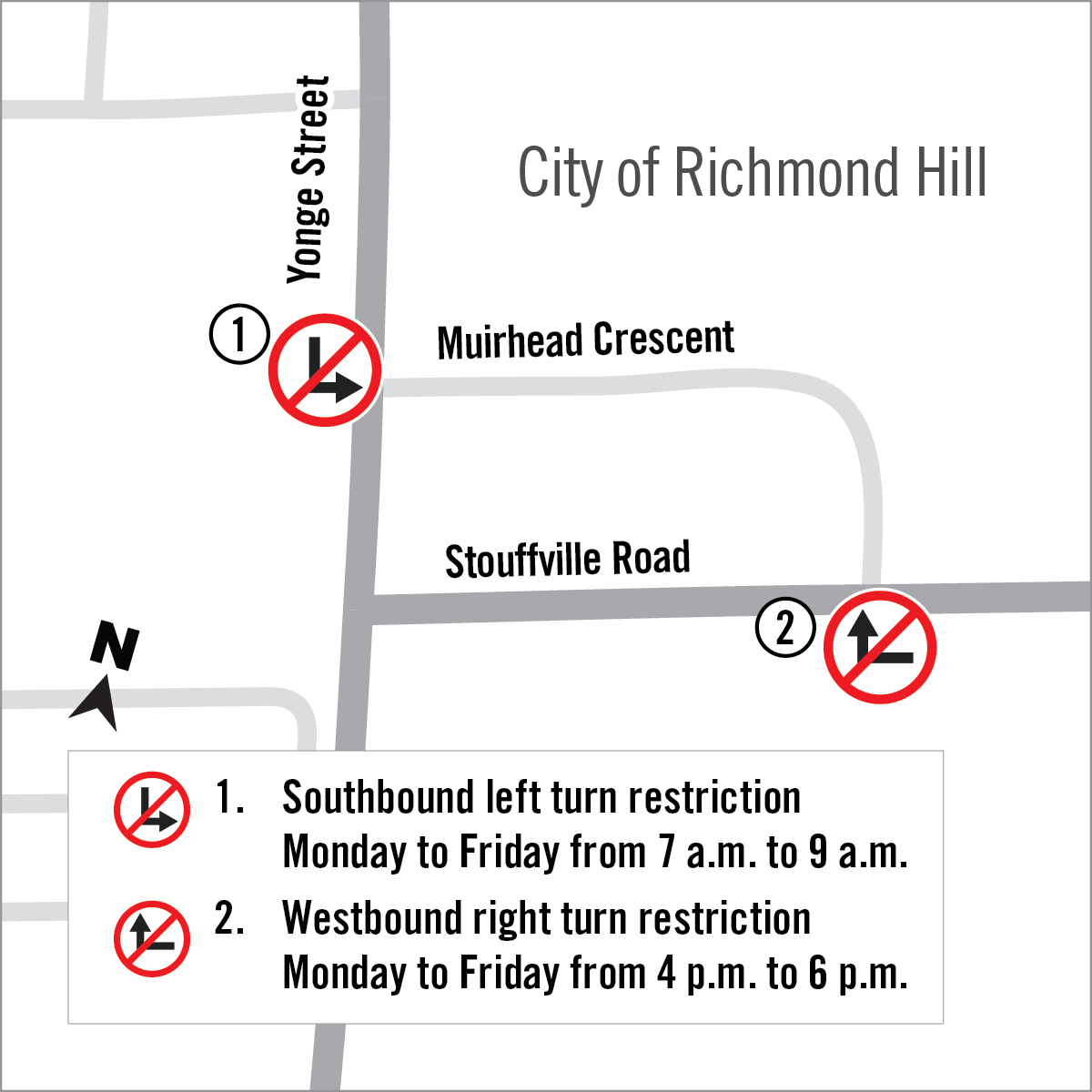
Safety Measures Implemented
- A southbound left turn restriction at Yonge Street and Muirhead Crescent, Monday to Friday from 7 a.m. to 9 a.m.
- A westbound right turn restriction at Stouffville Road and Muirhead Crescent, Monday to Friday from 4 p.m. to 6 p.m.
Frequently Asked Questions
Why were these safety measures implemented?
One of York Region’s top priorities is to reduce the number and severity of collisions that happen on Regional roads. Safety information and data are reviewed annually, and based on the results, improvements are made across the Region. This could include making improvements to existing roads and intersections, improving the design of new roads, law enforcement and raising public awareness.
When will these safety measures be implemented?
Turn restrictions will be implemented in summer 2026
How will these safety measures be enforced?
York Regional Police will enforce.
How was this plan shared with the community?
York Region mailed postcards to area residents, provided information on york.ca and promoted on social media.
The Region will continue to monitor these intersections and implement justified improvements. As part of the Vision Zero Traveller Safety Plan, the Region will ensure road safety measures are designed in a way that maximizes safety and balances efficiency for all road users.
Intersection Safety Pilot
In June 2019, York Region Staff presented to Regional Council a Pedestrian and Cyclist Safety Improvements Council Report. The report included a comprehensive data review indicating that the probability of injury to pedestrians and cyclists in motor vehicle collisions is significantly higher compared to other modes of travel. Pedestrians and cyclists are at high risk with vehicles turning at signalized intersections on Regional roads. More than 80% of all pedestrian and cyclist collisions in the Region involve a vehicle turning at signalized intersections and serious injuries are sustained in approximately 95% of collisions.
Implemented Safety Measures
Safety measures to help protect pedestrians and cyclists were implemented in 2019 at four signalized intersections.
In October 2021, York Region Staff provided Regional Council the Pedestrian and Cyclist Pilot Measures Report with results of the pedestrian and cyclist pilot measures implemented at the four pilot Regional intersections:
- Major Mackenzie Drive and Bayview Avenue in the City of Richmond Hill
- Yonge Street and Clark Avenue in the City of Markham
- Bathurst Street and Carrville/Rutherford Road in the City of Richmond Hill
- Bathurst Street and Clark Avenue in the City of Vaughan
Video data was collected before and after implementation of the measures to compare the results at each intersection. Overall, total collisions had reduced by more than 60%, and angle collisions, which typically result in serious injury, had reduced by 75%. These findings are comparable to industry reports prohibiting right turns at signalized intersections and implementing protected left turn movements may reduce pedestrian and cyclist collisions by more than 80%.
Collisions have been reduced at these four intersections. The performance of these enhancements was measured over one year. Based on the positive results, a recommendation to implement the measures at additional signalized intersections was included in the October 2021 Council Report. The safety measures have been implemented at the intersections listed below in the cities of Markham and Vaughan.
- 16th Avenue and Woodbine Avenue in the City of Markham
- 16th Avenue and Main Street Markham/Highway 48 in the City of Markham
- Highway 7 and Martin Grove Road in the City of Vaughan
- Highway 7 and McCowan Road in the City of Markham
- Highway 7 and Kennedy Road in the City of Markham
- McCowan Road and Carlton Road/Raymerville Drive in the City of Markham
- Kennedy Road at The Bridle Trail in the City of Markham
- Kennedy Road at Carlton Road in the City of Markham
Frequently Asked Questions
Why are these safety measures needed?
As York Region’s cities and towns evolve into urban centres, residents are choosing to walk and cycle more. Walking and cycling trips continue to increase at an average rate of 5% per year.
Pedestrians and cyclists are the most vulnerable travellers on the Regional transportation system. Almost all pedestrian collisions result in injury while cyclists sustain injury in almost 80% of all collisions. Pedestrians and cyclists lack personal protection compared to travellers in enclosed vehicles.
Past studies have indicated that pedestrian and cyclist collisions are not random events. Typically, these collisions result from mistakes made by one or more of the involved parties. These mistakes can be identified and counteracted through a combination of education, skill development, engineering and enforcement measures. Regional efforts are focused on ways to reduce the number of these occurrences.
The goal of the safety measures is to influence driver behaviour and create safer, more comfortable environments for pedestrians and cyclists.
Why were these four intersections selected for the pilot?
York Region conducted an extensive study over several months to prioritize intersections based on risk exposure to pedestrians and cyclists. The study also considered volumes of traffic, pedestrians and cyclists, and the number of collisions. The focus was on intersections that have traffic signals because the greatest risk for pedestrians and cyclists is when motorists are making turns at signalized intersections.
How many measures are being implemented?
During the study, many operational measures were evaluated based on effectiveness, applicability to Regional roads and time frame for implementation. The following safety features are proven to reduce pedestrian and cyclist collisions and are being implemented to suit the unique requirements of each of the four intersections.
- No right turn on red
- Protected left turns (left turns are only allowed during a dedicated green arrow)
- New signs to inform drivers that turning traffic must yield to pedestrians and cyclists
- A leading pedestrian phase (a head start for pedestrians crossing at an intersection)
What about other intersections in York Region?
York Region is committed to well-maintained, safe roads in all nine municipalities and continues to monitor the network and implement the following measures.
- Pedestrian-accessible intersections compliant with the Accessibility for Ontarians with Disabilities Act
- Tighter intersection curb radii in urban areas to slow turning vehicles and decrease the crossing distance for pedestrians
- More crossing time for pedestrians allocated at signalized intersections
- High visibility crossings to highlight potential pedestrians at intersections
- Pedestrian countdown signals to provide more awareness for pedestrians
- Leading pedestrian interval traffic signals to allow pedestrians a ‘head start’ when crossing
- Additional warning signage
- Separated bike facilities
How can residents play a role in enhancing road safety?
Road safety is not only engineering or police enforcement. It requires awareness and commitment among all travellers, for every trip. Pedestrians, cyclists and motorists share the Regional road network, taking close to three million trips every day.
Definitions
No right turn on red (NROR) during select times of the day: Reduces conflicts with pedestrians and cyclists who are crossing the road where vehicles are turning right, especially at locations with high pedestrian volumes and possible sight line restrictions. Implementing NROR only during select times of the day eliminates unnecessary delays, such as at night where there are no pedestrians, and focus on critical hours where traffic, pedestrian and cyclist volumes are the highest. This safety measure helps improve safety at intersections.
Pedestrian head start (also known as Leading Pedestrian Interval): An advanced walk signal for pedestrians to begin crossing the street before vehicles get a green signal. The purpose is to increase the visibility of pedestrians in the intersection and reinforce their right-of-way. Additionally, this measure is used to improve motorist yielding behaviour towards pedestrians where a crosswalk is present.
Fully protected left turn signal: A dedicated green left arrow signal where turning traffic can only enter the intersection and complete the turn when illuminated. This type of signal is required when there are insufficient sight lines, safety concerns and/or the intersection has a double left turn.
U-turn restriction: A "U-turn" is when a vehicle turns around on the road to go back in the direction it came from. As per the Highway Traffic Act, U-turns are allowed unless they are near a railway crossing, bridge or tunnel, curves in the roadway or approaching a hilltop. The Region may restrict U-turns in specific areas to improve safety and traffic flow. U-turn restrictions are implemented in areas where motorists may experience reduced visibility, limited space for turning, and/or a higher number of pedestrians walking on the roadway.
Additional warning signage: Informs motorists turning right that pedestrians and cyclists have the right-of-way within the intersection and must wait for the crosswalk to be clear. This safety measure increases motorists’ awareness and understanding of the pedestrian’s right-of-way within the intersection.
York Region continues to work with York Regional Police, Public Health and local cities and towns to protect our vulnerable road users. For more information, visit york.ca/TrafficSafety
General inquiries may be directed to:
York Region
Phone: 1-877-464-9675 ext. 75000 or dial 711 with a TTY device
Email: @email
After-hours emergency: 1-877-464-9675 ext. 75200