
Beach Water Testing
Beach Water Testing Program
The 2026 Beach Monitoring Season has officially concluded. We thank our municipal partners, residents, visitors and staff for their cooperation and support throughout the season.
Beach monitoring activities will resume at the start of the 2027 season.
Check before you splash!
To check if beach water is safe for swimming, check signs at the beach or check online before you go. That way you can make an informed decision before entering the water and avoid illness.
Check signs at the beach:
Red Sign
Beach status: "Advisory Posted"
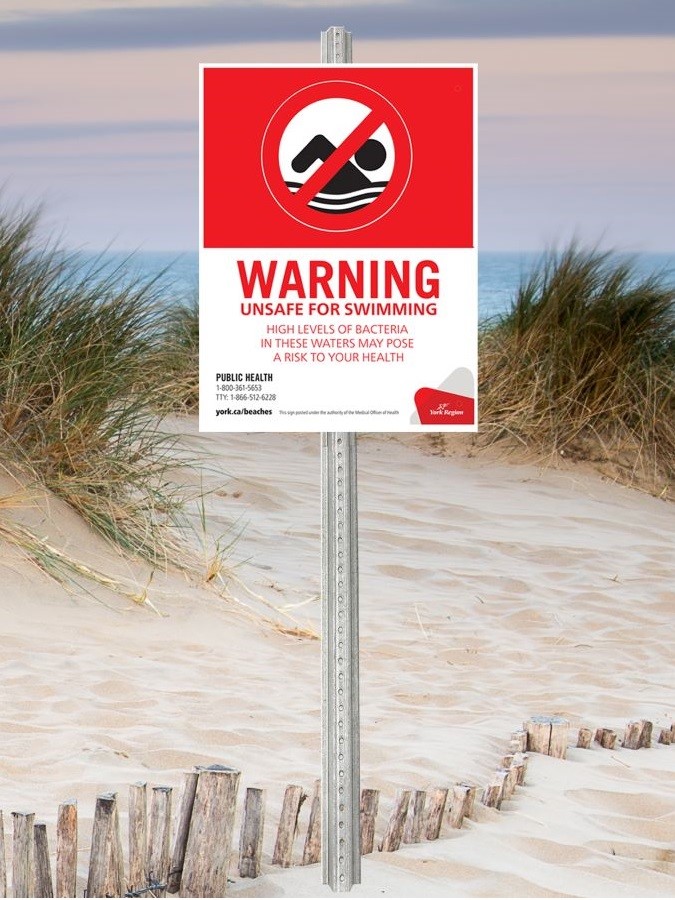
A red sign is a warning that the water may be unsafe for swimming.
It indicates that levels of E. coli bacteria in the water, at time of sampling, were high enough to pose a greater risk to your health.
When the bacterial levels in the water return to an acceptable level for swimming, the signs are changed to the blue sign.
Blue Sign
Beach status: "Acceptable"
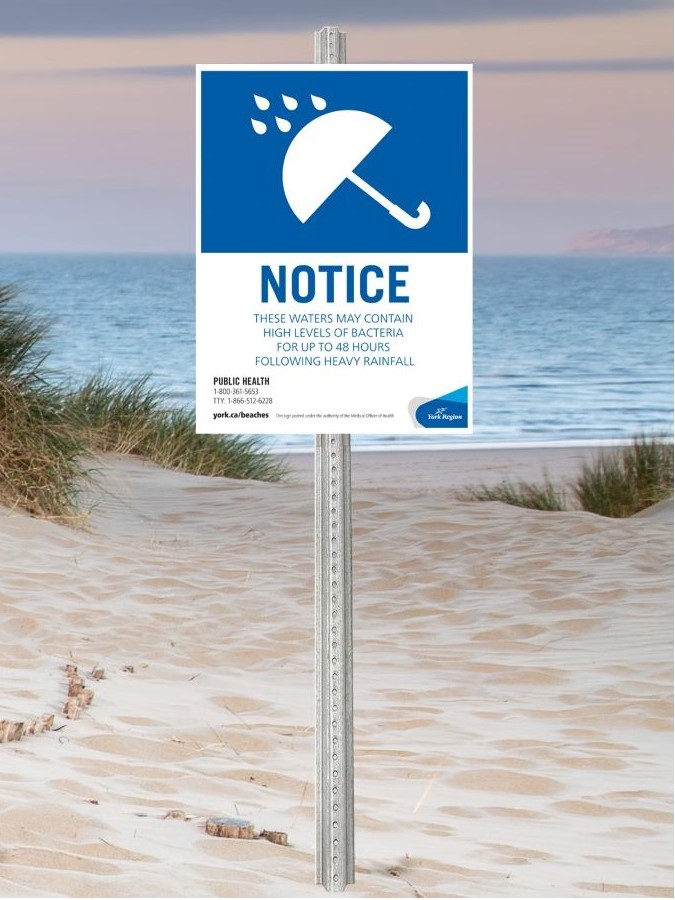
A blue sign indicates that levels of E. coli bacteria in the water appear to be within acceptable limits at time of sampling.
However, a blue sign also warns swimmers not to swim for two days after a heavy rainfall. This is because bacteria can increase after heavy rainfalls and be harmful.
Note: High waves can also stir up bacteria. If you cannot see your feet when standing in water up to your knees, it may be unsafe to swim due increased amount of bacteria in the water.
Water Quality Advisory Sign
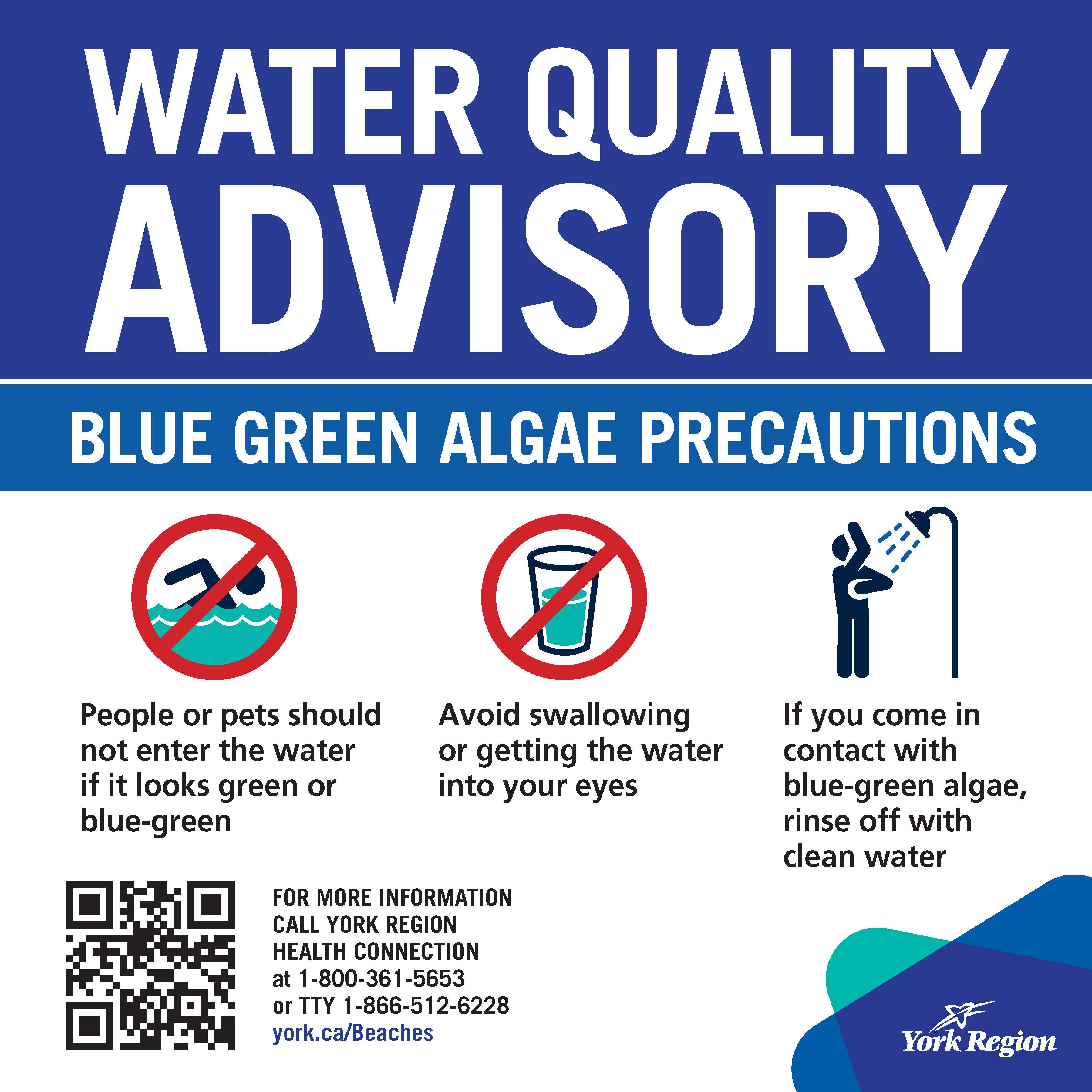
A water quality advisory sign is put up as a precaution when a harmful algal bloom, such as blue-green algae may be present.
It advises people and pets to take the following precautions:
- Do not enter the water if it looks green or blue-green
- Avoid swallowing or getting the water into your eyes
- Rinse off with clean water if you come into contact with blue-green algae
Check water quality online
Use the interactive map below to check if the water is safe for swimming at the beach you plan to visit.
Protecting swimmers from illness
Beaches are monitored to protect swimmers from illnesses that may be linked to high E. coli bacteria levels and harmful algal blooms.
Swimming in water with high E. coli bacteria levels can cause skin, ear, eye, nose and throat infections as well as stomach disorders, if the water is swallowed.
Some varieties of blue-green algae can produce toxins that are harmful to humans and animals. Exposure to these toxins can cause headaches, fever, diarrhea, abdominal pain, vomiting, skin rashes and irritation.
If you experience any of these symptoms following an exposure at the beach, seek medical attention.
More about the Beach Water Testing Program
Find out more about how York Region monitors the quality of beach water.
Beach Water Testing Program
During the beach water testing season, a minimum of five samples are collected from each public beach, usually twice a week, and are tested at the Public Health Laboratory for E. coli bacteria. Results are posted on signs at the beach and online.
Public beaches in York Region are also monitored during beach testing season for harmful algal blooms, including blue-green algae (cyanobacteria) blooms. In cases where blue-green algae blooms are suspected, testing is arranged through the Ministry of the Environment, Conservation and Parks. The Ministry has a comprehensive protocol for responding to occurrences of blooms of cyanobacteria. York Region will assess the risk in the event of a bloom and advise the public accordingly.
Harmful algal blooms (blue-green algae) and safety tips
Public beaches in York Region are also monitored during beach testing season for harmful algal blooms, including blue-green algae (cyanobacteria) blooms. In cases where blue-green algae blooms are suspected, testing is arranged through the Ministry of the Environment, Conservation and Parks. The Ministry has a comprehensive protocol for responding to occurrences of blooms of cyanobacteria. York Region will assess the risk in the event of a bloom and advise the public accordingly.
Blue-green algae (cyanobacteria) blooms can be identified by their blue green, turquoise, or olive-green colour. They look like scum, mats or paint floating on the water’s surface.
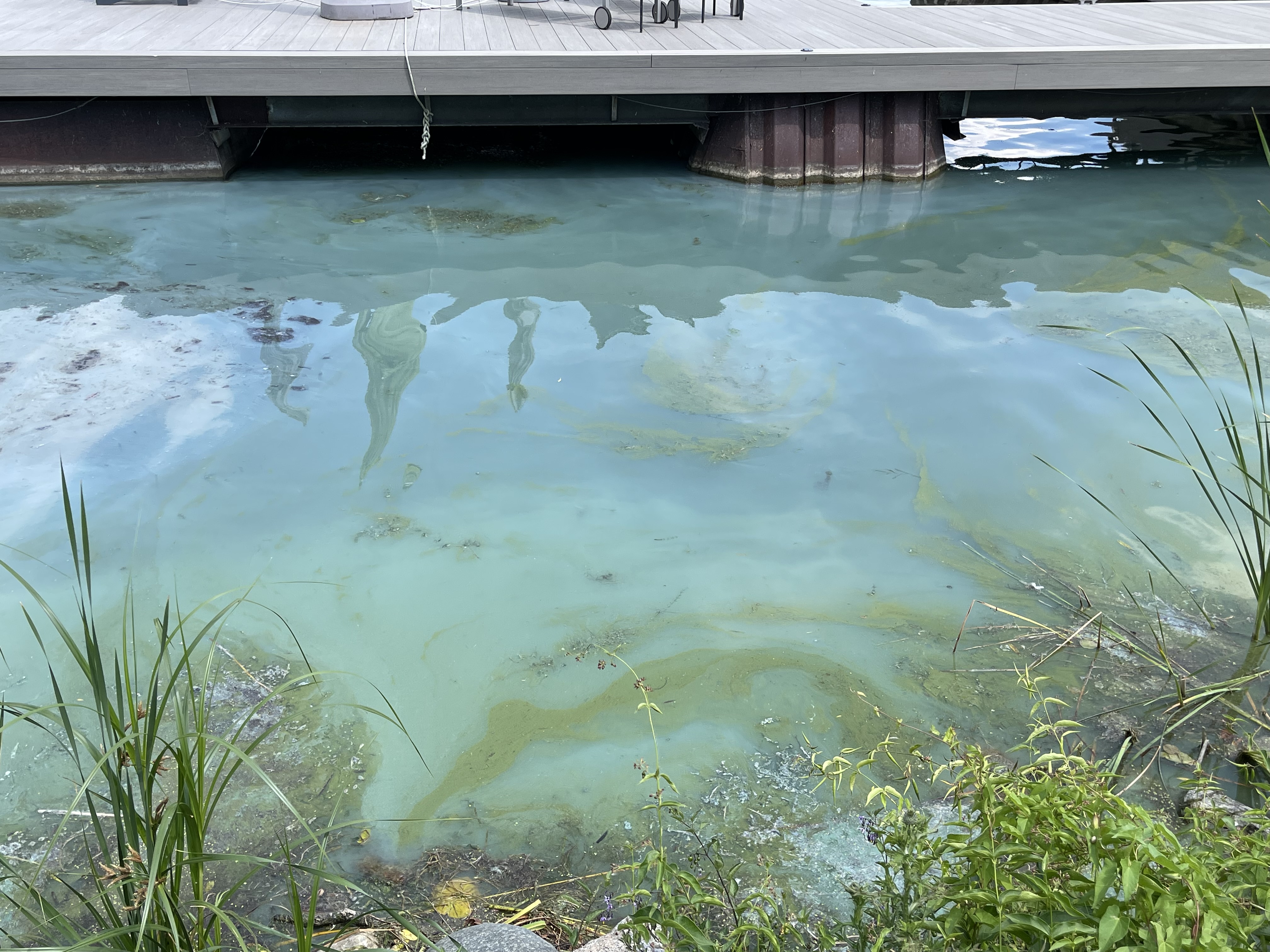
In the event of a bloom, take a cautious approach since some varieties of algae can produce toxins that are harmful to humans and animals. Exposure to toxins can cause headaches, fever, diarrhea, stomach pain, vomiting, skin rashes and irritation. If you experience any of these symptoms seek medical attention.
If you spot a bloom:
- Stay out of the water to reduce your chances of getting sick
- Avoid using, drinking, bathing or swimming in the water. If skin contact occurs wash well with soap and water
- If you supply your own water to your home from surface water (lakes and rivers) near a bloom, consider an alternate water supply for the duration of the bloom. Home water treatment systems may not remove toxins
- Restrict pet and livestock access to the water
- Be cautious when considering eating fish caught from a water body where blue-green algae blooms occur
- Follow these precautions for at least two weeks after the bloom has dissipated
- Contact the Ministry of Environment, Conservation and Parks Spills Action Centre at 1-800-268-6060 or online to report a bloom
List of beaches we monitor
York Region Public Health monitors water quality at the following public beaches as part of the Beach Water Testing Program:
Lake Simcoe
- Claredon Beach Park
6 Windy Shore Drive, Georgina - De La Salle Park
1940 Metro Road North, Georgina - Franklin Beach
753 Lake Drive East, Georgina - Holmes Point Park
144 Holmes Point Road, Georgina - Sheppard Avenue Park
791 Sheppard Avenue, Georgina - Jackson’s Point Beach/Bonnie Park
1 Bonnie Boulevard, Georgina - Joy Marritt Parkette
275 Church Street, Georgina
- North Gwillimbury Park
823 Lake Drive North, Georgina - Peninsula Resort
202 Holmes Point Road, Georgina - Riverview Park
99 Irving Drive, Georgina - Willow Beach Park
1545 Metro Road North, Georgina - Willow Wharf Dock
437 Lake Drive East, Georgina - Corner Park
105 Clovelly Cove, Georgina
Musselman's Lake
- Cedar Beach
15014 Ninth Line, Whitchurch-Stouffville
Help keep beaches clean
We all play a part in keeping our beaches clean. Here are some tips:
- If you live near the beach, make sure your plumbing fixtures are properly connected to your local municipal sewers or private sewage disposal system
- Fence livestock away from streams in farming communities
- Maintain runoff from feedlots and manure piles
- Do not feed animals or birds on the beach
- Do not leave your garbage behind when you visit the beach
- Obey local “stoop and scoop” bylaws
- Whenever boating practice pollution-free boating
For more information about the Beach Water Testing Program in York Region contact York Region Health Connection at 1-800-361-5653 or dial 711 with a TTY device.